The Rochdale Grooming Gang Deportation Loophole: How England Betrays Its Own
Let’s stop pretending this is complicated. A man at the heart of one of the worst grooming cases in modern British history is walking out of prison, stripped of British citizenship, yet still living in Britain because of a dusty bit of law from the early 1970s. That is the Rochdale grooming gang deportation loophole in plain English, and if you are angry, you should be.
I have watched this country for over four decades, following politics day in, day out, and there is a pattern you start to recognise. When the state wants to come after you for unpaid tax or a parking ticket, everything works like clockwork. When it comes to protecting English girls from organised rape gangs and removing the ringleaders, the machine suddenly becomes very slow, very “complicated”, and very sorry for itself.
In this piece, I am going to explain exactly who this man is, how the law is being used to shield him, and why every excuse you are hearing is just that – an excuse. I will also lay out what a serious country would be doing instead, and what you and I can actually do about it.
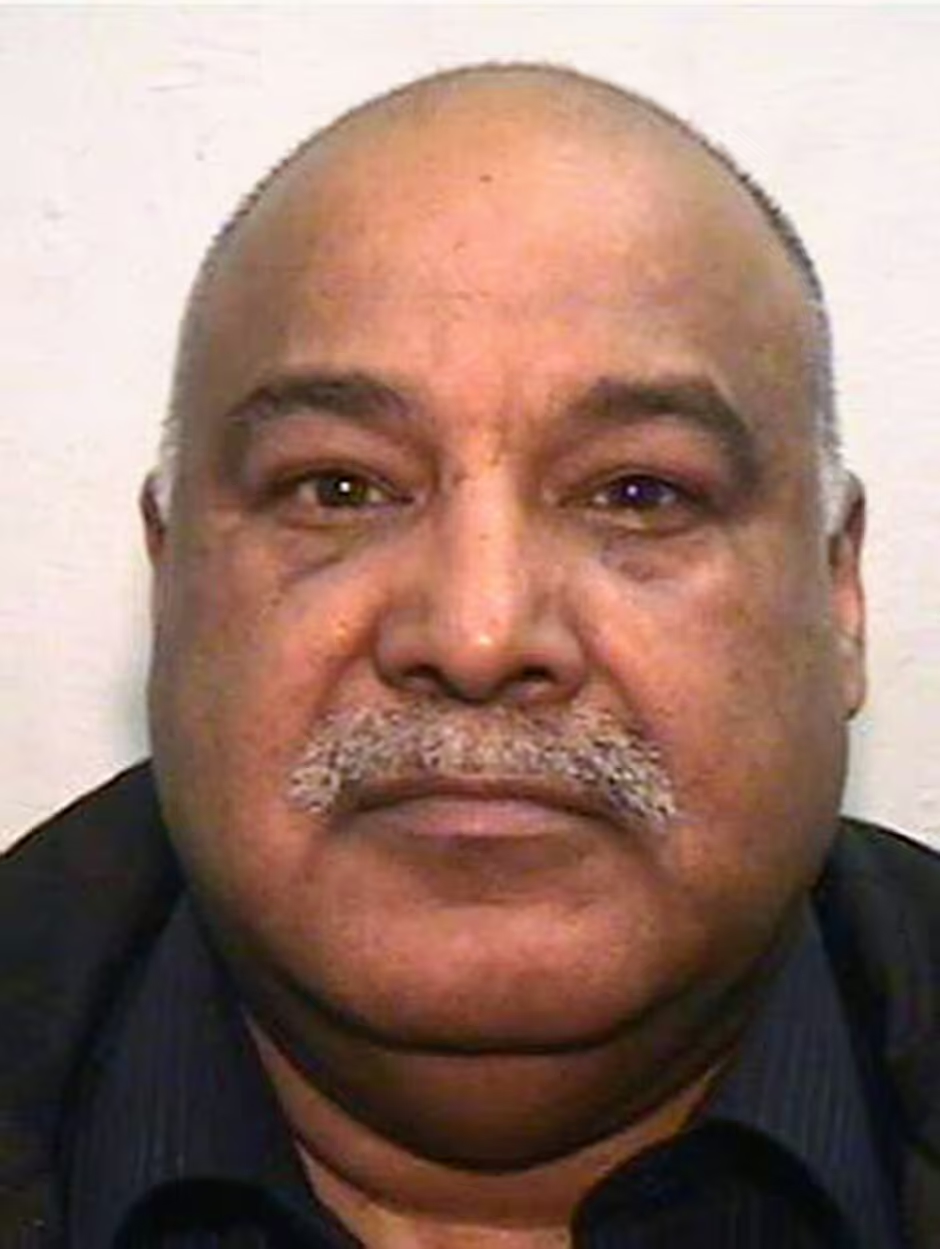
Who Is Shabir Ahmed – And Why He Is Still Here
Shabir Ahmed is not some minor figure on the edges of the case. He was identified as the ringleader of the Rochdale grooming gang, a group of men who targeted vulnerable girls, plying them with alcohol, drugs and attention before repeatedly sexually abusing them. He was convicted of multiple rapes and child sexual offences, with sentences amounting to more than 40 years in total. He is now in his seventies and, according to reports, is due for release.
The public were told that men like him would lose their British citizenship and be removed from this country. The courts backed the Home Office in stripping him of his British status, and that made headlines at the time. The quiet bit they did not shout about was this: he cannot actually be deported because of an old law that protects certain Commonwealth migrants from removal.
So we are now in the absurd position where a man who came here from Pakistan, abused English girls on an industrial scale, lost the right to call himself British, and yet still gets to live here under state supervision. If you want a neat symbol of where this country’s priorities lie, that is it.
I have seen every excuse rolled out over the years – “our hands are tied”, “we must follow the rule of law”, “we cannot comment on individual cases” – and it always seems to appear when the establishment would rather endure public outrage than face down the system it built.
The Immigration Act 1971 – The Quiet Shield Protecting Grooming Gang Rapists
Here is where the Rochdale grooming gang deportation loophole comes in. The block on deporting Ahmed does not come from Brussels or Strasbourg this time. It comes from the Immigration Act 1971, a British law that predates most of the people reading this.
That Act contains a provision which says that certain Commonwealth citizens who came to the UK before 1 January 1973 cannot be deported, no matter how bad their crimes. The idea at the time was to give “settled” Commonwealth migrants some security. On paper, that might have sounded fair enough in an era when nobody was talking about grooming gangs and mass migration as we know it now.
But laws do not live in museums. They operate in the real world. Today, that same provision shields a Pakistani-born ringleader of a child rape gang from ever being removed from the UK, even though his British citizenship has been stripped. The state has effectively said, “You are not one of us, but we are stuck with you.”
Whenever the establishment trips over one of its own booby traps like this, you hear the same line: “We must respect the law.” Fine. Respect it – then change it. Parliament is sovereign. If this law produces outcomes that any normal person would regard as grotesque, Parliament can amend it, abolish it, or carve out exceptions for serious sexual and violent offenders. The fact it has not done so tells you that the political will simply is not there.
Renouncing Pakistani Citizenship: Gaming the System By Design
To make matters worse, this is not just about one man. Other members of the Rochdale grooming gang, like Qari Abdul Rauf and Adil Khan, have spent years playing legal games to avoid removal to Pakistan. They were convicted in 2012 as part of the same abuse scandal, involving dozens of girls over a two-year period.
These men have challenged deportation on human rights grounds, arguing that being sent back to Pakistan would breach their rights, while publicly available reports suggest some have renounced Pakistani nationality, making it easier to claim they have “nowhere to go”. Meanwhile, negotiations between London and Islamabad drag on for years, and the British public is told to be patient.
This is not an accident. It is a system built to be exploited by anyone ruthless enough to do it. If you or I tried tearing up our passport and telling the state we no longer recognised its authority while claiming every possible benefit of living here, we would not get very far. But if you are part of a high-profile grooming gang, there will always be another legal angle to try and another appeal to lodge.
As an English nationalist, I see this not as a bug, but as a design choice. The political class spent decades constructing a migrant-first, criminal-friendly set of laws and treaties. Now, when that framework protects the worst people you can imagine, we are told it is sacred and untouchable.
“Monitored For Life” – Why Tags, Curfews and Registers Are Not Justice
To calm public anger, officials stress that Ahmed will be under strict conditions when he leaves prison. They talk about lifelong inclusion on the sex offenders’ register, electronic tagging, curfews, exclusion zones around Rochdale, and 24-hour supervised accommodation. Any breach of these conditions, they assure us, will see him returned to custody.
Let me translate that. The British taxpayer will now fund the entire security operation needed to watch a man who should not be in this country at all. Every tag, every officer, every bed in that supervised accommodation, comes out of the pockets of the very people whose children were put at risk in the first place.
More importantly, none of this is justice. It is risk management. A tag does not undo a single rape. A curfew does not rewind the clock for any of those girls. This is the state saying: “We will tolerate this threat on your streets, but do not worry – we have a spreadsheet for him.”
In my view, this obsession with “managing” dangerous offenders rather than removing them or locking them up for life is a symptom of a bureaucracy that sees everything as a process problem, not a moral one. Once you reduce victims and offenders to case numbers, it becomes very easy to accept outcomes that would have horrified an earlier generation.
Police, Councils and Political Cowardice: The System That Failed Those Girls
The rot did not begin in a courtroom. It started years before, when girls were first being abused and the system looked the other way. We know, from official reviews, that Greater Manchester Police and Oldham Council failed to share crucial information about Ahmed’s earlier sexual offences against children, despite concerns being raised. Investigators later found “serious multiple failures” and admitted that earlier disclosure could have prevented further abuse.
Think about that. The state now tells us it is doing everything it can, tagging and monitoring and issuing stern press statements. But when it actually mattered – when these girls were being targeted – it fumbled the basics. It did not share information. It did not act decisively. It did not treat working-class English girls as people worth taking a risk for.
I have been watching councils and forces behave like this for decades. Time and again, reputational management and “community cohesion” are put ahead of honesty and protection. The phone calls are made behind closed doors. The language is carefully managed. And the message to ordinary people is always the same: “We know best, and you must not make a fuss.”
The Rochdale grooming gang deportation loophole is just the latest stage of that same mentality. The system makes a mess, then asks you to accept the consequences as if there was no alternative.
What a Serious Country Would Do About Grooming Gangs
If England were serious, the conversation we would be having now would not be about tags, curfews, or how expensive lawyers are. It would be about changing the law and changing the culture that produced this mess.
First, the Immigration Act 1971 exemption for pre-1973 Commonwealth citizens would be amended to remove protection from deportation for anyone convicted of serious sexual or violent offences. There is no sane argument for treating a child rapist as a protected historic migrant. Parliament could pass that change in months if it really wanted to.
Second, deportation would be automatic for any foreign citizen or dual national convicted of serious crimes, especially offences against children. That is the direction some cases have gone, with courts upholding removal for other groomers, but it remains far too patchy and slow. No endless appeals churned through on legal aid for men who have already cost the country enough.
Third, there would be no early release schemes for child rapists, full stop. Even Jess Phillips, hardly a figure of the nationalist right, has argued that child rapists should be excluded from planned early release programmes. If politicians across the spectrum can say that on television, they can write it into law.
Fourth, police and councils that fail in their duties would face real consequences. Not just “lessons learned” reports, but dismissals, professional bans, and criminal charges where wilful neglect can be shown. The people who chose to protect careers rather than children must never quietly move sideways into another role.
This is what a serious country would be debating. Instead, we are fed the idea that our hands are tied by laws that the same politicians could change tomorrow.
What Ordinary English People Can Actually Do
You might read all this and think, “What is the point? They are going to do whatever they want anyway.” I understand that instinct. But resignation is exactly what keeps this entire machine going.
Here are a few concrete things you can do as an ordinary English person who is sick of the Rochdale grooming gang deportation loophole and everything it represents.
You can support victims’ groups and charities that help survivors of abuse, especially those outside the fashionable NGO bubble. Their voices carry more weight than any politician’s carefully scripted outrage, and they need resources to keep pressing for change.
You can contact your MP, in writing, and ask specific questions: Do you support removing the 1971 exemption that blocks deportation of serious offenders? Do you back automatic deportation for foreign and dual-national child rapists? Do you support a ban on early release for such offenders? Then you keep their answers, share them, and remember them at election time.
You can stop relying solely on legacy outlets. Build and back independent English nationalist media, Substacks, YouTube channels, Telegram groups, and local networks that do not have to tiptoe around “community tensions”. If the establishment will not tell the truth, we can.
And you can refuse to be gaslit into thinking that wanting rapists deported, laws updated, and girls protected makes you “extreme”. It does not. It makes you a normal, decent person in a country that badly needs more of them.
If you agree with this, share it, talk about it, and do not let this story disappear like all the others. Silence is exactly what allows the next loophole to be written.
FAQs
1. Why cannot the Rochdale grooming gang ringleader be deported?
Because of a clause in the Immigration Act 1971 that shields certain Commonwealth citizens who came to the UK before 1973 from deportation, even after serious convictions. Shabir Ahmed falls under that pre-1973 category, so although his British citizenship has been removed, he cannot currently be removed from the UK.
2. What is the Rochdale grooming gang deportation loophole?
The loophole is that the state can strip citizenship from offenders like Ahmed, talk tough about deportation, yet still be blocked from actually removing them by the 1971 Act’s pre-1973 Commonwealth protections. It lets the government look “tough” while leaving dangerous men in the country under supervision instead of sending them home.
3. Why are grooming gang members being released early from prison?
Like other offenders, grooming gang members are often eligible for release after serving part of their sentence, subject to licence conditions and monitoring. There are also wider government plans to expand early release to manage prison overcrowding, which is why some politicians are now calling for child rapists to be specifically excluded.
4. What monitoring conditions do grooming gang offenders face after release?
In Ahmed’s case, reports say he will be on the sex offenders’ register for life, wear an electronic tag, follow strict curfews and exclusion zones, and live in 24-hour supervised accommodation. Any breach of these licence conditions is supposed to trigger immediate recall to prison.
5. What changes are needed to stop this happening again?
Key changes include removing the 1971 pre-1973 deportation shield for serious offenders, making deportation automatic for foreign or dual-national child rapists, and banning early release for such crimes. There must also be real consequences for police and councils that fail to act on grooming gang intelligence, not just another round of “lessons learned”.