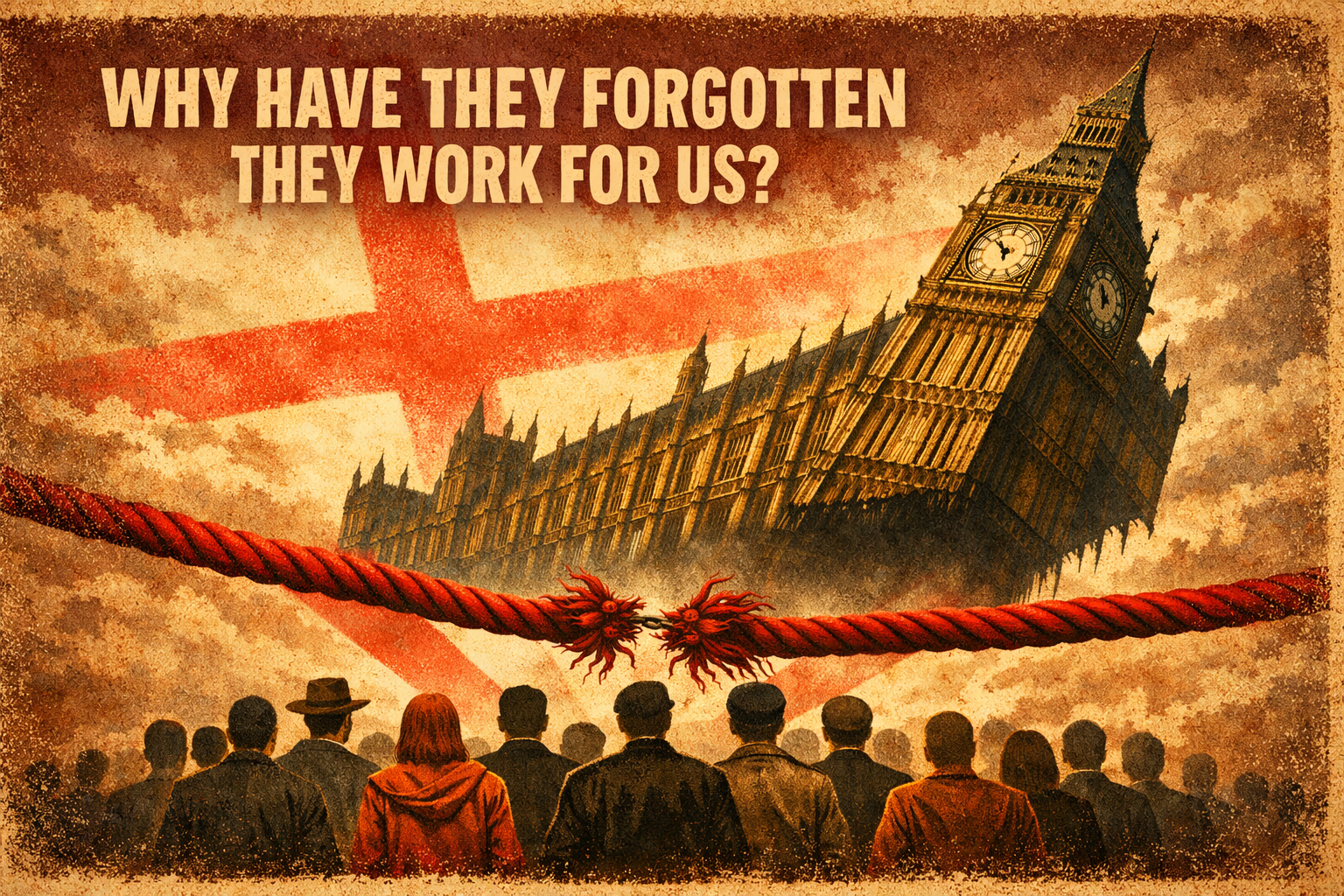
From grooming gangs to tax and the cost of living, an English answer to a state that no longer serves its own people.
Introduction: They Work for Us – Remember?
At some point, Westminster seems to have forgotten a basic fact: they work for us, not the other way round.
They are paid, housed, chauffeured and pensioned by English taxpayers, yet look around you. Girls betrayed and abandoned in grooming gang scandals. Crime that goes unpunished while the police obsess over online comments. A tax burden at record highs. A cost of living that feels like slow strangulation.
You are told to tighten your belt, pay a bit more, “understand the pressures.” They never tighten theirs. They never miss a meal, or a mortgage payment, or a bonus.
I have spent nearly forty years watching Westminster and Whitehall. Watching ministers promise, commissions report, inquiries “learn lessons”, and nothing fundamental change. The pattern is now too obvious to ignore.
So here is the question that keeps coming back: if they have forgotten they work for us, how do we remind them?
Letters, petitions and elections haven’t done it. Maybe it is time to talk about something sharper, but still peaceful and lawful: coordinated, one‑day days of action – showing what happens when ordinary English men and women simply stop playing along for 24 hours.
Would that make them sit up and take notice? Let’s be honest about what has happened, who is to blame, and what an English answer might look like.
What Has Happened to This Country?
Look at four areas and you see the same rot.
Grooming gangs.
For years, mainly northern towns saw organised abuse of vulnerable English girls. Police knew. Councils knew. Some MPs knew. The system looked the other way. In some places, they even blamed the families rather than the men raping their daughters. Reports stack up, apologies are issued, but the same “lessons will be learned” script is rolled out like an old pantomime.
Crime and policing.
Ask anyone outside the Westminster bubble: does it feel safer than it did twenty or thirty years ago? For most people, the answer is no. Knife crime, street assaults, shoplifting on an industrial scale. Yet you see the police chasing retweets, rainbow campaigns and thought‑crime while burglars and thugs walk free. The basic deal – pay your taxes, we’ll keep you safe – has been broken.
Tax.
English workers are hammered from every angle: income tax, National Insurance, council tax, fuel duty, VAT on almost everything you touch. Families with both parents working full time still feel skint by the third week of the month. Meanwhile, waste and vanity projects multiply. Billions disappear into schemes you never voted for and could never stop.
Cost of living.
Energy bills, food prices, rent and mortgages – all up. Wages? Not so much. People who work hard, do the “right thing”, and try to raise children without relying on the state are punished. The political class shrugs it off as “headwinds” while they claim expenses and second homes.
If English nationalism means anything in practice, it has to start here: your own people are suffering in your own country, and your own state shrugs.
That is not a serious country. That is a country where the rulers have lost any fear of the ruled.
Why Has This Been Allowed to Happen?
None of this is an accident. It is the product of a political class that no longer feels any real obligation to the English.
For decades, I have watched them on the box, at the despatch box, doing the same dance.
- Professional politicians, not public servants.
We now have a caste who enter politics straight from special adviser roles, think tanks and lobby firms. They do not see themselves as servants of an English nation. They see themselves as managers of a “UK brand” in a global marketplace. - Party before country.
When grooming gangs came to light, what was the first instinct? Protect vulnerable girls? No. It was to protect “community cohesion”, avoid headlines, and keep the party machine smooth. Crime numbers, migration numbers, economic numbers – they are treated as PR problems, not matters of right and wrong. - No price for failure.
I have lost count of how many times a scandal has broken, the minister has “taken responsibility” by resigning… and popped up six months later with another plum job. Senior officers retire on full pensions. Council bosses move sideways. No one at the top ever seems to face a real consequence. - A hollowed‑out democracy.
Every few years, you get to choose which colour of rosette reads the same script. The policies barely move. The promises are recycled. Ask yourself: when was the last time a general election actually changed the basic direction of travel on crime, tax, immigration, grooming gangs or the cost of living?
The painful truth is this: they behave like this because they think you will grumble and put up with it.
You will shout at the telly, moan in the pub, maybe post on social media – and then go back to work, pay your taxes, keep the system alive.
Who Is to Blame?
It is easy to say “the government” and leave it there. But part of being serious – as an English nationalist or just as a grown‑up citizen – is naming the layers.
Westminster politicians.
They sign the laws, set the budgets and appoint the people. They cannot hide behind “the system”. If you sat on the government benches while grooming gangs were ignored, or while tax and bills squeezed people dry, you share the blame.
Senior police and officials.
Not the bobbies on the beat trying to do a job with no numbers. The leadership. The chiefs who decided to deprioritise “sensitive” crimes. The council heads who buried reports. The CPS managers who quietly shelved cases that might cause “community tension”.
The wider establishment.
Large parts of the media, quangos, NGOs and corporate world have joined in de‑nationalising politics. To them, English nationalism is an embarrassment, something to be quarantined. They prefer safe, global slogans to facing what is happening to actual English people.
But we have to be honest with ourselves too.
We, the English public, carry a share.
How many times did we hold our noses and vote for “the least bad”? How often did we swallow another broken promise because “there is no alternative”? I include myself in that. Years of watching this circus can numb you. You start to expect betrayal.
That has to stop. Blame starts at the top, but responsibility for change starts with us.
What Would a Serious Country Do?
Imagine, just for a moment, that we lived in a serious country that still believed in itself.
On grooming gangs, a serious country would:
- Launch a truly independent national inquiry with full powers to compel evidence.
- Sack and, where appropriate, prosecute officials who covered up or neglected their duties.
- Put victims first in law and practice, not as a line in a speech.
On crime, a serious country would:
- Restore visible policing as a core duty, not a photo opportunity.
- Stop treating repeat violent and sexual offenders as if they are “unfortunate cases.”
- Back officers who enforce the law properly, instead of sending them on endless PR and diversity courses.
On tax and the cost of living, a serious country would:
- Accept that you cannot forever squeeze the productive middle while wasting money at the top.
- Strip out vanity projects and quango empires before asking for another penny from people who are already struggling.
- Treat the English taxpayer as the person who keeps the lights on, not as a captive cow to be milked.
And behind all of that, there would be a basic moral line: the first duty of the state is to its own people.
That is English nationalism in practice. Not flags and slogans, but a hard, cold insistence that the English are not to be used, ignored or sacrificed for other people’s comfort.
We are not there. Which brings us to the question: if they will not act like a serious country, how do we force the issue – without violence, without stupidity – as English men and women?
Could One‑Day English Days of Action Work?
This is where the idea of coordinated one‑day days of action comes in.
I am not talking about riots. I am not talking about smashing up your own streets, or attacking random people. That stupidity only helps the people who want to paint every English nationalist as a thug.
I am talking about this: what happens if, for one day, we simply stop feeding the machine?
Imagine a “Day of English Action” where:
- As many people as possible take a day’s leave, unpaid or paid, or simply refuse overtime.
- Small businesses either close for the day or donate a visible chunk of that day’s takings to victim support or legal challenges.
- Retired people and those out of work join local vigils, stand outside town halls, or simply refuse discretionary spending for 24 hours.
- Social media is flooded, not with random anger, but with one clear English nationalist demand: justice for grooming gang victims, real punishment for criminals, lower tax and an end to being bled dry.
You do not break the law. You do not attack anyone. You simply withdraw your cooperation for a day and make it visible.
Would one day on its own change everything? No. Of course not. I have watched too much politics to believe in silver bullets.
But here is what it would do:
- It would show there are English people who are done with moaning and are prepared to take real, peaceful action.
- It would give you a way to show anger without handing the state an excuse to crack down.
- If repeated – once a month, or tied to key dates – it would become harder and harder for Westminster and the media to ignore.
The point is not to “bring the country to its knees.” The point is to remind the people in charge that the country already is on its knees in many places – and that the English are not going to stay kneeling forever.
What Can Ordinary English People Actually Do?
Most people are not in a position to go on indefinite strike. You have jobs, families, mortgages. You cannot just walk away. I get that.
So any serious English nationalist plan has to give realistic options for different situations.
If you are employed.
- Use annual leave or unpaid leave when you can to join a day of action.
- If you cannot take the day off, you can still join the consumer side: no unnecessary spending, no extras, no treating that day like business as usual.
- Use your breaks and evenings to email your MP, your PCC, your council – and make it clear you are linking your vote to grooming gangs, crime, tax and living costs.
If you are self‑employed or run a small business.
- Close for the day with a simple notice: “Closed for Day of English Action – we have had enough of paying more and getting less.”
- Or stay open but donate a percentage of that day’s takings to a cause that hits the point – victim support, a legal fund, a pressure group. Put that fact on the door.
If you are retired or not working.
- Join local gatherings, vigils or even just stand quietly outside a council office with a sign.
- Help with the online side: share, comment, push the same key messages so the algorithm cannot bury them so easily.
- Support younger family members who want to take part but are nervous. Sometimes just knowing their parents or grandparents approve is enough.
And for everyone:
- Stop voting for people who spit in your face. If your MP has looked the other way on grooming gangs, crime, tax and living standards, stop rewarding them.
- Build English networks. Use email lists, local meetings and online groups to coordinate, not just to vent.
None of this is glamorous. It is not the fantasy revolution some people talk about online. It is slow, grinding pressure. But that is how serious movements work.
Conclusion: They Have Forgotten – So Remind Them
They have forgotten they work for us.
They have forgotten that the English are not cattle to be milked, not spare parts to be thrown away when they get in the way, not a backdrop for their careers.
I cannot make you angrier than the facts already should. Girls betrayed in grooming scandals. Crime that goes unpunished. Taxes that never stop rising. A cost of living that makes honest work feel pointless. Decades of broken promises and managed decline.
What I can say, as someone who has watched this circus for nearly forty years, is this: nothing changes while we just complain.
So here is my blunt suggestion:
- Start talking seriously about peaceful, coordinated, one‑day English days of action.
- Pick clear demands.
- Use your digital channels, your conversations, your spending – and, when you can, your labour – to show you are done being ignored.
No violence. No stupidity. But no more quiet obedience either.
If they have forgotten they work for us, then it is time we reminded them – as English men and women who still care what happens to our own country and our own people.
FAQs
1. What do you mean by an English day of action?
A peaceful, coordinated 24 hours where English people withdraw as much cooperation as they realistically can: taking leave, cutting discretionary spending, and making visible demands on grooming gangs, crime, tax and the cost of living.
2. Is this the same as a general strike?
No. A general strike usually means mass, open refusal to work, often organised by unions. A day of action is more flexible and individual: some take leave, some shut businesses, others focus on consumer and digital actions.
3. Is this legal?
You must stay within your contract and the law. That means using lawful leave, not inciting violence or disorder, and focusing on peaceful pressure. The whole point is to make a stand without giving the state an excuse to crack down.
4. Why link grooming gangs, crime, tax and cost of living?
Because they are all symptoms of the same problem: a state that has stopped putting its own people first. English nationalism means connecting these failures and demanding that your own people matter again.
5. Will one day of action really change anything?
One day alone will not fix decades of decay. But it is a starting point. Repeated days, backed by clear demands and growing numbers, can force the media to cover the issue and remind politicians that the English are not content to be silent taxpayers forever.


One thought on “Why Have They Forgotten They Work for Us?”