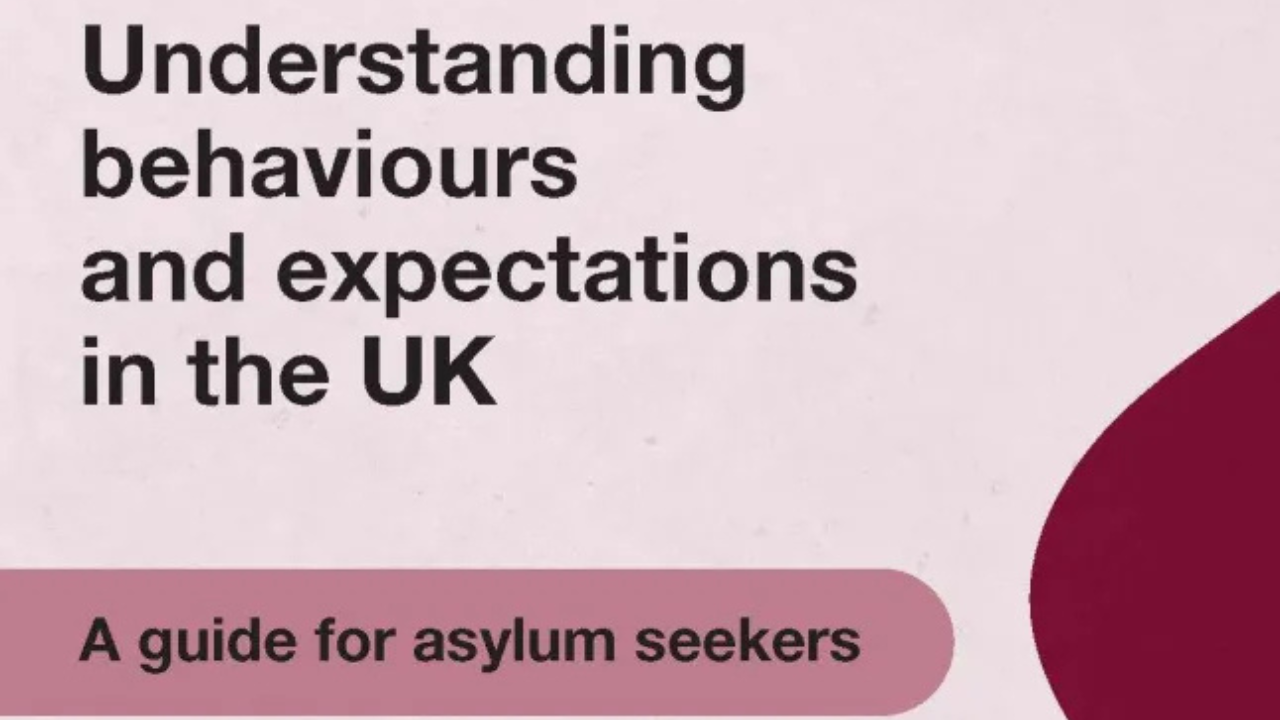
The Home Office has issued a guide for asylum seekers living in the UK.
It explains that women are equal to men.
It explains that rape is illegal.
It explains that domestic abuse is illegal.
It explains that children cannot consent to sex.
It explains that forced marriage and female genital mutilation are crimes.
It explains that you should respect people in public and not harass, threaten or intimidate them.
Let that sink in.
This is not a leaflet explaining how to use the NHS.
It is not a guide to British bank holidays.
It is not a helpful explanation of where to register with a GP or how to use public transport.
It is a Government booklet spelling out basic standards of civilised behaviour to people seeking asylum in this country.
And before anyone starts screaming “racist” or “Little Englander”, let us get one thing straight.
I have lived and worked abroad myself.
From 1992 until 2010, apart from 1993 to 1995 when I was ill with TB, I lived or worked in Amsterdam, Gran Canaria, Tenerife, Scotland, Ibiza, Oman and Fuerteventura.
I was the outsider in other people’s countries.
I was the person expected to respect the laws, customs and people of the place I had chosen to live or work in.
That is normal.
That is what decent people do.
I was never handed a booklet telling me not to rape women, not to beat a partner, not to sexually harass people in the street, not to force a child into marriage or not to treat women as inferior.
Why not?
Because those are not complicated cultural differences.
They are not quirky British traditions.
They are basic standards of human behaviour.
So when the British Government thinks it needs an asylum seeker behaviour guide, we are entitled to ask a simple question:
What exactly has gone so wrong that this is now necessary?
This is not about every asylum seeker.
It is about the Government admitting, through its own actions, that it believes some new arrivals may not understand or accept standards that should not need explaining.
And its answer is a pamphlet.
A pamphlet.
What the Government has published
On 19 August 2026, the Home Office published Understanding behaviours and expectations in the UK: a guide for asylum seekers.
The official booklet covers gender equality, domestic abuse, sex and consent, respect in public, and where people can get help. The Government says these laws and expectations apply to everybody living here.www+1
Nobody sensible objects to people being told the law.
Nobody objects to people being given clear information when they arrive in a new country.
If somebody has escaped war, persecution or chaos, information about their rights, responsibilities and where to get help may be useful.
That is not the point.
The point is what this particular guidance has to explain.
The Government has chosen to include basic warnings around rape, sexual harassment, domestic abuse, forced marriage, female genital mutilation and sex with children.
Why?
Either ministers believe that some people arriving here need it spelling out, or they do not.
If they do not, why issue it?
If they do, why are they pretending this is merely a routine bit of helpful information rather than an admission that there are serious cultural and safeguarding concerns?
The Home Office cannot have it both ways.
This is not a problem a leaflet can solve
This is the madness of modern Britain.
The Government allows people to enter or remain in the country through a system that the public plainly does not trust.
It struggles to remove people with no right to be here.
It puts large numbers of asylum seekers into hotels and temporary accommodation.
It asks overstretched councils, police forces, schools, NHS services and local communities to absorb the consequences.
Then, when concerns are raised about integration, women’s safety, crime, cultural compatibility or public order, the public is told to shut up.
Or it is told that any concern is “far-Right”.
Then the same Government releases a guide explaining that rape is illegal.
What are we supposed to think?
A leaflet cannot screen a person’s background.
A leaflet cannot establish whether somebody is telling the truth about who they are.
A leaflet cannot remove a dangerous offender.
A leaflet cannot make somebody respect England, English women, English law or English life.
A leaflet cannot repair a border that has ceased to command public confidence.
And a leaflet certainly cannot deal with the consequences when the Government has imported a problem it was too weak, too frightened or too ideological to face honestly.
A serious country does not substitute paperwork for border control.
The real issue is control
The argument will now be deliberately distorted.
People will say this is about hating foreigners.
It is not.
They will say it is about pretending every asylum seeker is a criminal.
It is not.
They will say that providing information is sensible.
Of course it is sensible.
But it is not enough.
The real issue is whether England controls who enters, who stays, who is removed and what standards apply once someone is here.
For decades, Westminster has behaved as though the public has no right to ask.
Numbers rise.
Communities change beyond recognition.
Housing gets tighter.
Public services are stretched.
Women raise concerns about safety and harassment.
People see crimes and behaviour that would once have been called unacceptable.
Then they are instructed to ignore their own eyes.
I have watched politics and the news closely for more than 40 years. I have seen Westminster promise control, then fail to deliver it. I have watched politicians call every concern “unfounded”, only for them eventually to admit there was a problem after the damage was done.
That is why people no longer trust them.
Not because people are stupid.
Not because people are evil.
Because they have been lied to too many times.
Respect goes both ways
When I lived and worked abroad, I understood something very simple.
I was a guest.
That did not mean I had no rights.
It did not mean I had to be silent about everything.
It meant I had a responsibility to respect the place I was in.
Its laws.
Its people.
Its culture.
Its basic standards.
If I had behaved badly, caused trouble, committed crimes or acted as though the country should change itself around me, I would not have expected applause.
I would have expected consequences.
That is the normal arrangement.
You go somewhere else, you respect the country.
You do not demand that the country lowers its standards for you.
You do not insist that women change their behaviour to accommodate your beliefs.
You do not expect local people to accept harassment, intimidation, violence or abuse because you come from somewhere with different norms.
And you certainly do not get to call the people whose country you have entered racist for expecting you to obey the law and integrate.
This is not extreme.
This is common sense.
The fact that common sense now needs defending tells you how far things have gone.
Who is responsible?
Not every asylum seeker.
Not every migrant.
Not every person who arrives legally or illegally.
The responsibility lies first with the people who run the system.
It lies with governments that allowed border control to become a slogan rather than a reality.
It lies with ministers who preferred good headlines to difficult decisions.
It lies with officials who built a system that seems quicker at processing paperwork than removing people who should not be here.
It lies with politicians who treated the concerns of ordinary English people as embarrassing.
And it lies with the political class that thinks a behaviour guide is an answer.
The Home Office says the booklet is for asylum seekers and covers expectations while living in the UK. It is not officially described as a leaflet solely for people arriving by small boat, so we should be accurate about that.www+1
But accuracy does not remove the larger question.
Why is it needed at all?
Why are basic rules around women, children, consent and violence being presented as a special induction subject for newcomers?
And why is the response to that concern always to attack the people asking it rather than the Government that created the situation?
What a serious country would do
A serious country would begin with one basic principle:
The border matters.
That does not mean abandoning compassion.
It means recognising that compassion without control becomes chaos.
A serious country would:
- Secure the border and stop illegal entry being treated as a route into long-term residence.
- Process claims quickly and fairly, rather than leaving people in limbo for years.
- Remove people with no legal right to stay once appeals are exhausted.
- Deport foreign nationals who commit serious crimes, wherever the law allows it.
- Properly verify identity, background and security risks before settlement.
- End the use of hotels as a lazy, expensive substitute for a functioning system.
- Make integration an expectation, not an optional extra.
- Require respect for English law, equality before the law and the safety of women and children.
- Give communities a genuine say before large-scale accommodation is imposed on them.
- Tell the truth when policies fail instead of smearing the public for noticing.
And yes, people should be told clearly what the law is.
But that should be part of a system that has control, standards and consequences.
Not a substitute for one.
What ordinary people can do
The public has been trained to think its only choices are silence or rage.
That is rubbish.
There are practical things people can do.
Ask your MP whether they support secure borders, fast decisions and removal for failed claims.
Ask whether they think an asylum seeker behaviour guide is enough.
Ask how many asylum seekers are being housed in your council area, what the cost is, what safeguarding is in place and whether local people were consulted.
Use Freedom of Information requests where appropriate.
Support groups that deal honestly with immigration, integration, women’s safety and national sovereignty without spreading nonsense or blaming innocent people.
Do not pass on fake stories just because they fit what you already believe. The truth is strong enough. We do not need invented claims.
And refuse to be bullied into silence by the usual names.
“Racist.”
“Bigot.”
“Flag shagger.”
“Little Englander.”
Those labels are designed to stop ordinary people asking obvious questions.
They are not arguments.
I have lived outside England. I know what it is like to be the person arriving in somebody else’s country. That is exactly why I believe respect, integration and acceptance of local law are not optional.
They are the minimum standard.
England is allowed to expect better
England is not wrong to expect safe streets.
England is not wrong to expect women and girls to be safe.
England is not wrong to expect children to be protected.
England is not wrong to expect newcomers to obey the law, respect the country and integrate into it.
And England is not wrong to expect its Government to control the border before it starts handing out leaflets explaining the most basic rules of civilised behaviour.
The Home Office may call it a guide.
Fine.
But the existence of the guide says far more than ministers want to admit.
It says that Government knows there is a problem.
It says that it is worried enough to spell out things no decent adult should need explaining.
And it says that, instead of dealing with the cause, it is once again managing the consequences.
That is not control.
That is decline administered through a pamphlet.
England deserves better than that.
We need secure borders, honest politicians, proper integration, firm enforcement and a Government that understands its first duty is to the safety and confidence of its own people.
Not more excuses.
Not more hotel bills.
Not more lectures.
And not another leaflet pretending that a country can keep itself safe by asking dangerous or incompatible people nicely to behave.
FAQs
What is the asylum seeker behaviour guide?
It is a Home Office booklet published on 19 August 2026 explaining behavioural expectations for asylum seekers living in the UK. It covers gender equality, domestic abuse, sex and consent, respect in public and getting help.www
Is the guide only for people arriving by small boat?
No. The Home Office describes it as a guide for asylum seekers living in the UK. It is not officially limited to people who arrived by small boat.www+1
Does the guide say rape and domestic abuse are illegal?
Yes. The guidance covers sex and consent, domestic abuse, respect in public and gender equality, including information about criminal behaviour and where to seek help.www
Is it racist to expect newcomers to respect English law?
No. Expecting everyone in England to obey the law, respect women and children, and treat others decently is a basic standard that should apply to everybody.
What would a serious asylum system look like?
It would secure the border, process claims quickly, remove failed claimants after due process, verify identities, deport serious foreign offenders where legally possible, and expect integration and respect for English law.