
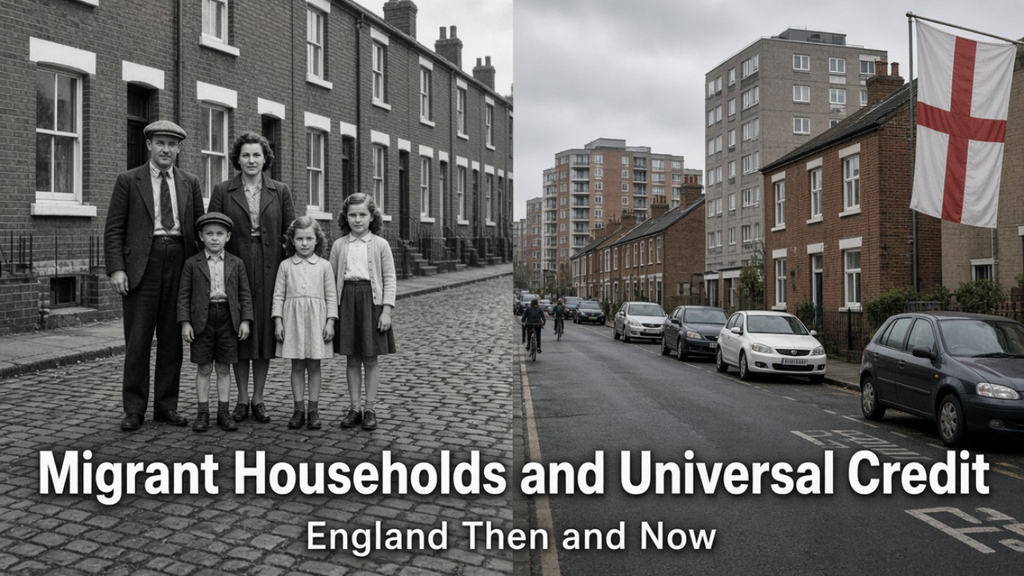
The figure is £11.9 billion. That is the amount reportedly paid in Universal Credit during 2025 to households containing at least one foreign national.
Let that sink in.
At a time when English families are watching every pound, pensioners worry about heating bills, young people cannot get on the housing ladder, councils are cutting back services, and working people are taxed from every direction, nearly £12 billion is being paid through one benefit to households that include foreign nationals.
That is not a minor administrative detail. It is a serious national question.
And it is one that far too many politicians, civil servants and media commentators seem frightened to discuss honestly. The moment anyone raises concerns about immigration, welfare or the pressure placed on public services, the usual routine begins. You are told you are cruel. You are told you are uninformed. You are told you must not believe your own eyes when you see the strain on housing, schools, GPs, roads and local budgets.
Well, ordinary English people are not stupid.
They can see what is happening. They can see that the country has changed at a pace no government has properly planned for. And they are right to ask a simple question: why should England continue to carry costs that its leaders have refused to control?
The reported DWP figures show a steep rise. Payments to households containing at least one foreign national rose from £7.5 billion in 2023 to £9.5 billion in 2024, then to £11.9 billion in 2025. That was said to represent 15.6% of Universal Credit spending. Around £7.7 billion of the total was linked to claimants classed as jobless.
Those numbers deserve a frank response, not another lecture from people who never seem to queue for a GP appointment, struggle to find an affordable rental property, or wonder why full-time work no longer guarantees a decent standard of living.
The £11.9bn figure matters
Before anyone tries to twist the facts, let us be accurate.
The figure refers to households containing at least one foreign national. It does not mean that every pound was paid directly to a foreign national, because some households will be mixed nationality and may include British citizens or British-born children.
That distinction matters. Facts matter.
But it does not make the issue disappear.
Even on the most cautious reading, the figure tells us that a very large and rapidly rising share of Universal Credit spending is going to households with a foreign-national member. The total has risen by more than £4 billion in only two years, from £7.5 billion to £11.9 billion.
Any government that respected taxpayers would explain why.
It would publish clear figures on how many claimants are working, how many are unemployed, what immigration statuses are involved, how long people have lived here, and how much of the spending is driven by housing costs, childcare, disability, low wages or joblessness.
Instead, the public is too often expected to accept a vague assurance that everything is under control.
It plainly is not.
This is not about blaming every person born abroad. Many people have come to Britain, worked hard, paid taxes, raised families, started businesses and contributed greatly to our communities. England has always benefited from people who come here in good faith and make a genuine contribution.
But contribution is the point.
A country cannot remain cohesive if the people who fund it are repeatedly told that they have no right to ask whether the system is being used fairly.
England is not a cash machine
I have lived abroad. That experience teaches you something valuable: other countries do not automatically treat newcomers as entitled to everything the moment they arrive.
In many places, you are expected to stand on your own feet. You work. You pay into the system. You prove that you are genuinely resident. You follow the rules. You build a record.
That is how it should be.
My own view is straightforward: before anyone who has arrived from abroad can claim a penny in means-tested benefits, they should be able to show a minimum of five years of tax receipts. Five years of actual contribution. Five years of payslips, tax records, National Insurance payments and lawful residence.
Not promises. Not paperwork designed to get around the rules. Not a claim made within months of arrival while English families who have paid into the system all their lives are told there is no money for social care, local policing, council services or affordable homes.
A five-year contribution requirement would not be radical. It would be basic fairness.
It would say to those who come here lawfully: you are welcome to work, build a life and become part of the country. But you cannot arrive with one hand out before you have put anything into the pot.
That principle would still need sensible exceptions. Genuine refugees fleeing war or persecution are not ordinary economic migrants and should be treated humanely. People with severe disabilities, victims of trafficking and those in exceptional hardship require proper safeguards. A civilised England does not turn its back on genuine need.
But compassion must not become a blank cheque.
There is a difference between helping people in a genuine emergency and creating a system where the taxpayer is expected to bankroll an ever-growing bill without proper limits, transparency or democratic consent.
The present rules are too unclear
Under the current system, a person must meet eligibility conditions before claiming Universal Credit. They must ordinarily live in the UK and have an immigration status that permits recourse to public funds, alongside the other entitlement requirements.
Many people subject to immigration control cannot claim because their status includes “No Recourse to Public Funds.” In addition, the habitual residence test looks at whether someone has a qualifying right to reside and has genuinely made the UK their home.
That is the theory.
The trouble is that the public sees the outcome, not the guidance manual.
They see ever-higher welfare bills. They see overcrowded housing. They see social-housing waiting lists that seem never to end. They see their local council saying it has no money. They see young English people still living with parents because rents are too high and deposits are impossible. They see people who have worked their whole lives struggling to get help.
Then they hear that almost £12 billion in Universal Credit has been paid to households containing at least one foreign national.
You do not need to be a political extremist to understand why people feel angry.
The rules may technically exist, but a rule that ordinary people cannot see being enforced quickly loses public confidence. If the state wants public support for legal migration and genuine humanitarian protection, it must show that access to welfare is controlled, conditional and fair.
At present, the system looks too complicated, too opaque and too open to exploitation.
Working people are carrying the burden
The modern British state has developed a bad habit. It takes more from people who work and gives less back in return.
Income tax. National Insurance. VAT. Council tax. Fuel duty. Duties on alcohol and tobacco. Hidden costs in energy bills. Higher rents caused by a lack of supply. The list goes on.
For millions of working people, especially those just above the threshold for support, life can feel like a permanent squeeze. They are not rich enough to absorb every rise in costs. They are not poor enough to qualify for much help. They simply keep paying.
These are the people who make the system function.
They get up in the morning, commute, run small businesses, work shifts, care for relatives, pay bills and try to give their children a decent start. They are not asking for special treatment. They are asking for a government that puts its own people first when making decisions about public money.
That should not be controversial.
It is not “anti-immigrant” to believe that welfare must be based on contribution. It is not hateful to believe that citizens and long-term taxpayers should come first in access to scarce resources. It is not unreasonable to ask why a country that cannot house its own young people properly keeps expanding obligations that it has not planned or paid for.
The real insult is that political leaders have allowed this question to become taboo.
A system based on contribution protects everyone. It protects taxpayers from abuse. It protects genuine migrants from resentment caused by poor policy. And it protects public support for the welfare state itself.
Because if working people conclude that the system is fundamentally unfair, they will stop believing in it.
England is paying the price locally
Westminster likes national averages. Local people live with consequences.
The pressure is not evenly spread across the country. In London and the South East, the struggle for housing is relentless. Private rents have become absurd in many areas. Social housing is scarce. Temporary accommodation costs are putting councils under enormous strain.
Elsewhere, the problems take different forms.
In towns across the Midlands, the North and coastal England, people may face lower rents but weaker job markets, overstretched GP surgeries, long waits for appointments, packed classrooms and public transport that does not meet local need. In some places, rapid population change has been imposed without the homes, services or local funding required to cope with it.
Then, when people complain, they are told they should be grateful for growth.
Growth for whom?
If a town gains more residents but does not gain more homes, more school places, more GP capacity, more policing and better-paid work, that is not growth felt by local people. It is pressure.
England has a long history of welcoming people who come to work, settle and contribute. But welcoming people does not mean abandoning all limits. Nor does it mean ignoring the needs of the communities already here.
A serious government would connect immigration numbers to local capacity. Before substantial new arrivals are placed in an area, there should be a clear plan for housing, schools, health services, transport and work.
Instead, too often the bill lands on local councils and local residents.
That is not planning. That is passing the problem down the chain.
Welfare should follow contribution
The old British understanding was that welfare was there when people hit hard times. It was not meant to be an open-ended invitation to access support before making a meaningful contribution to the country.
That does not mean we should return to Victorian cruelty or pretend that every person in need is to blame for their circumstances. It means remembering that the welfare state survives only when people think it is reciprocal.
You contribute when you can. You receive help when you genuinely need it.
That is why the two-year tax-receipt rule makes sense.
If you come here to work, then work. Pay tax. Pay National Insurance. Put something into the country before drawing from it. After a sustained period of contribution, you should have the same protection against genuine hardship as anyone else who has played by the rules.
That is fairer than basing public support on confusing immigration categories that few ordinary people understand.
It is also fairer to the many migrants who do work hard. They should not be lumped together with people who abuse the system. A contribution-based model makes the standard clear for everyone.
Of course, no rule should be so rigid that it abandons a refugee family with nothing after they have escaped war, or leaves a child without food because of the choices made by adults. But exceptions should be narrow, transparent and subject to proper checks.
The basic presumption must change.
Britain should no longer operate as though access to welfare is part of the welcome package. It should be something earned through lawful residence and measurable contribution.
The low-pay model is failing everyone
There is another side to this that politicians often avoid.
England has allowed too many employers to rely on cheap labour while the taxpayer picks up the consequences. If an employer pays wages too low to cover rent, food, transport and childcare, the welfare system is often left to plug the gap.
That is not a successful labour market. It is a subsidy for low-paying business models.
It harms English workers who are undercut or pushed out of sectors where pay and conditions have been allowed to stagnate. It harms migrant workers who may arrive expecting opportunity but find insecure work, high rents and dependence on support. And it harms taxpayers, who are asked to pay the difference.
The answer is not merely to increase or decrease immigration numbers and declare victory.
The answer is to insist on proper wages, enforce employment law, stop exploitative recruitment practices, and ensure that employers who benefit from overseas labour meet their responsibilities. If a business cannot survive without paying wages that leave its workers reliant on state assistance, it is not the taxpayer’s duty to rescue that business model.
The same principle applies to public services. If immigration is used to fill staffing gaps in the NHS, social care or other essential sectors, then government must also provide the housing and infrastructure needed for those workers and their families.
You cannot import labour, ignore capacity, and then accuse local people of intolerance when they ask why their town is under strain.
What should change now
The £11.9 billion figure should be a turning point.
Not a call for mindless anger. Not an excuse for abuse against individuals. But a turning point in how England thinks about welfare, immigration and the duty of government to the people already here.
A serious reform programme would include the following:
- A minimum five-year record of tax and National Insurance contributions before a newly arrived foreign national can access means-tested working-age benefits, subject to tightly defined humanitarian exceptions.
- Clearer public data separating mixed-nationality households, working households, jobless households, immigration categories and length of residence.
- Firm enforcement of No Recourse to Public Funds rules for people whose visas contain that condition.
- Faster decisions and better checks so that fraud, false claims and rule-breaking are dealt with promptly.
- A stronger expectation that those able to work should be supported into work quickly, including English-language training, skills recognition and employer links.
- Tougher action against employers who use migrant labour to hold down wages or evade basic standards.
- A local infrastructure guarantee, so areas receiving substantial population growth receive extra money for homes, GPs, school places, roads and council services.
- A renewed commitment to build homes for English families and long-term residents who have spent years paying into the system.
None of this is extreme.
It is what a serious country does when it values both fairness and social cohesion.
England must put its people first
For too long, the political class has treated English concern as something to be managed rather than respected.
People are told that they must accept rising population, rising housing demand, rising welfare costs and rising pressure on services, while being grateful for the privilege of paying for it all.
That is not sustainable.
A country has borders for a reason. A welfare state has conditions for a reason. Taxes are collected for a reason. The first duty of any government is to the people it governs: the citizens, families and taxpayers who keep the country going.
That does not require hatred. It requires priorities.
We can treat people decently while insisting that England is not a soft touch. We can offer sanctuary to genuine refugees while expecting able-bodied adults to work. We can welcome those who want to build a life here while refusing to create a system that rewards arrival before contribution.
The reported £11.9 billion in Universal Credit paid to households containing at least one foreign national should force a national reckoning.
The question is not whether England can afford endless arguments. The question is whether it can afford to keep avoiding the obvious one:
When will the people who pay in finally come first?
If you want more plain-speaking commentary on England’s past, present and future, follow England Then and Now and share this article with someone who is tired of being told that obvious concerns are somehow beyond discussion.
Frequently asked questions
How much Universal Credit was paid to households containing foreign nationals?
Reported DWP figures show that households containing at least one foreign national received £11.9 billion in Universal Credit during 2025. This was reported as 15.6% of Universal Credit spending.telegraph+1
Does £11.9 billion mean all payments went directly to migrants?
No. The reported figure relates to households with at least one foreign-national member. Some of these will be mixed-nationality households and may include British citizens or British-born children.
Can foreign nationals claim Universal Credit?
Some can, depending on their immigration status and whether they have recourse to public funds. Many temporary visa holders cannot claim because they are subject to No Recourse to Public Funds conditions. Claimants may also need to meet habitual residence and right-to-reside rules.www+2
Should migrants need to pay tax before claiming benefits?
That is a policy choice rather than the current general rule. A contribution-based system could require a newly arrived person to show a minimum period of tax and National Insurance payments before accessing means-tested benefits, while preserving narrowly defined exceptions for refugees and other genuine humanitarian cases.
Why is this an issue for England?
The impact is experienced locally through pressure on housing, council budgets, GP appointments, school places, low-paid work and social cohesion. National immigration and welfare policy should be tied to investment in local infrastructure so established communities are not expected to carry the cost alone.