
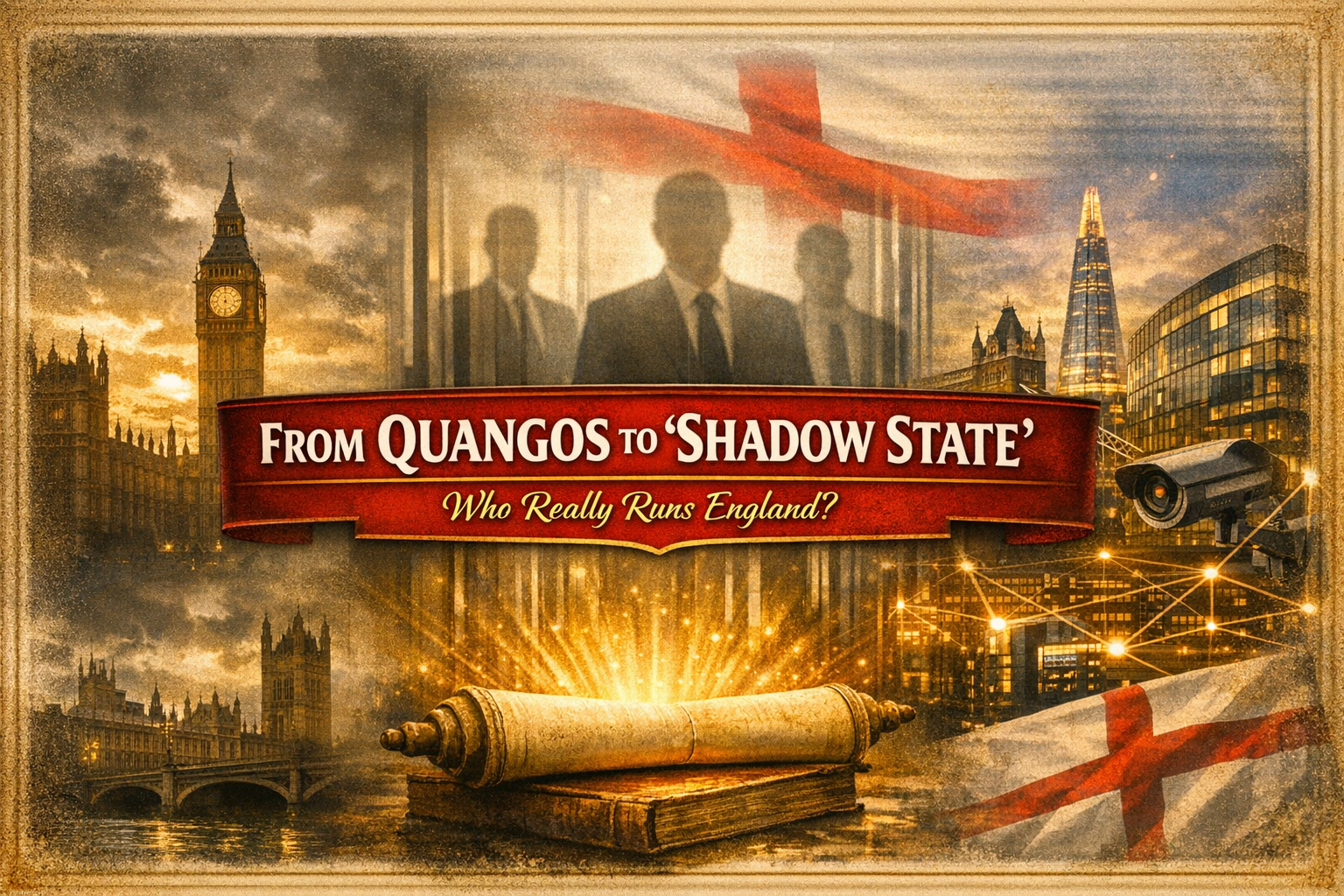
Introduction: The Government in England You Never Voted For
Living through forty years of elections, manifestos and ministerial reshuffles, you start to notice something uncomfortable about how England is actually run. Governments come and go, Prime Ministers rise and fall, yet much of what affects daily life in England never really changes hands.
That’s because a huge slice of power in England doesn’t sit with the people you vote for at Westminster. It sits with boards, regulators and “arm’s‑length” bodies you’ve never heard of, spending eye‑watering sums, writing rules, and shaping culture – all without a single ballot being cast for any of them. That’s the journey from quangos to “shadow state” in England, and once you’ve seen it, you can’t unsee it.
In this article, I’ll explain what these bodies are, how they’ve grown into a kind of parallel government for England, why it matters for your taxes, your freedoms and even your savings, and what real reform would look like. I’ll also share some personal observations from four decades of watching English politics, listening to voters, and seeing the same unelected machinery carry on regardless of who sits in Downing Street.
What Are Quangos – And How Do They Govern England?
Let’s start with a clear, England‑focused definition. A “quango” is a quasi‑autonomous non‑governmental organisation. In practice, that usually means:
- It is funded largely or entirely by the UK state.
- It exercises public power – regulating, inspecting or distributing money.
- It sits at arm’s length from ministers and is run by appointed boards, not elected representatives.
In England, these quangos and arm’s‑length bodies are everywhere once you know to look:
- Regulators that decide what can be broadcast on TV and radio.
- Agencies that oversee exam standards and school inspections.
- Bodies that manage England’s rivers, coasts and flood defences.
- Authorities that plan and deliver major rail and road projects in England.
- Organisations that control large chunks of health, arts and housing funding in England.
You may think “the government” is making these decisions, but very often it’s these semi‑detached bodies acting in England’s name.
Now, there is a reasonable argument for having some arm’s‑length institutions. Ministers cannot personally:
- Run every hospital in England.
- Inspect every school.
- Decide every grant to every arts organisation.
So the idea was to create expert bodies, give them a clear remit, and let them get on with it. In theory:
- Politicians set the law and broad policy.
- Quangos implement within those boundaries.
- The public ultimately holds politicians to account.
The trouble is that in England, this neat theory has been choked by reality. We have slid from quangos to “shadow state” – from a few specialist bodies to a dense network of institutions that effectively govern large parts of English life, without meaningful democratic oversight and often with a worldview of their own.
How England Drifted From Quangos to “Shadow State”
Looking back over four decades, what stands out is that almost every crisis, scandal or “reform” in England has ended with more arm’s‑length bodies, not fewer.
A familiar pattern repeats:
- A department in Whitehall is criticised for failure in English services – say, schools, health or rail.
- The response is to “take the politics out of it” by setting up a new “independent” commission, agency or regulator.
- Another quango is born, usually with a board of “experts” and a mandate that quietly expands over time.
Through the 1980s and 1990s, England saw an explosion of agencies and regulators attached to UK departments but overwhelmingly operating in England:
- Inspectorates monitoring English schools, hospitals and care homes.
- Regulators overseeing energy, water and communications infrastructure used by English households.
- Funding councils directing research, arts and regional development money into English institutions.
By the 2000s and 2010s, devolution added another twist. Scotland, Wales and Northern Ireland developed their own explicit political institutions. England, by contrast, remained mostly governed from Westminster – but the day‑to‑day machinery increasingly ran through quangos.
So for England we ended up with:
- UK‑level departments that formally cover the whole country.
- A large web of quangos and agencies that, in practice, govern English services.
- No dedicated English Parliament to scrutinise this structure properly.
When people talk about a democratic deficit in England, this is a big part of it. You can change which party runs Westminster, but you rarely change:
- Who chairs the big regulators.
- Who sits on the boards of major funding bodies.
- The culture inside inspectorates and authorities that run English systems.
Over the years I’ve watched ministers proclaim “bonfires of the quangos” more times than I can count. A few smaller bodies get merged or renamed; the overall quango jungle remains. For England, especially, the shadow state has become part of the furniture.
The Money England Never Explicitly Agreed To Spend
If you really want to understand the scale of England’s shadow state, follow the money.
Across the UK as a whole, hundreds of billions of pounds flow through quangos each year. A huge share of that spending relates directly to services in England – English schools, English healthcare structures, English transport networks, English environmental management.
To put this into perspective for an English taxpayer:
- Roughly a third of all government spending is channelled through quangos and arm’s‑length bodies.
- A large proportion of that third is spent on things that matter primarily in England, because that’s where most of the population lives and where many functions are not devolved.
Over four decades I’ve seen the same pattern:
- Rail agencies and infrastructure bodies responsible for English lines burn through colossal budgets while passengers in England endure crowded trains and unreliable services.
- Environmental and water bodies overseeing England’s rivers and coasts preside over sewage spills and flooding problems, yet their leaders continue to receive comfortable salaries and, in some cases, bonuses.
- Cultural and arts funding organisations operating largely in England funnel grants into niche projects that reflect fashionable ideology far more than they reflect the concerns of ordinary English communities.
On paper, all of this sits neatly in departmental budgets and accounts. In reality, most English taxpayers have no idea:
- How many such bodies exist.
- How much of “their” money they consume.
- What exactly the country receives in return.
If a family in England managed its household like this, it would be as if:
- One third of the household income was handed to a group of neighbours.
- The neighbours decided how to spend it, wrote their own job descriptions and even voted themselves pay rises.
- The family could never actually replace those neighbours – only occasionally complain when the food runs out.
We would call that ludicrous. Yet for England, that is strikingly close to how a big chunk of public money actually moves. That is what people sense when they talk about England being run by a shadow state – they can feel that decisions and money are being handled somewhere beyond their reach.
The Accountability Gap in England: Power Without an English Ballot Box
The most worrying thing about from quangos to “shadow state” in England isn’t simply the waste; it’s the way it hollows out accountability.
Quangos sit in a murky position:
- They are not fully private – they depend on public money and public authority.
- They are not fully political – they’re appointed, not elected.
This creates what I’d call an English accountability gap:
- When English services fail – in health, transport, education or the environment – ministers can say, “That’s an independent body; we don’t interfere in their decisions.”
- Quango leaders can say, “We’re simply working within the framework Parliament set,” as if that erases their responsibility for how they interpret and apply that framework in England.
- Ordinary English voters find there is no direct way to reward or punish these bodies at the ballot box. They can only swap the minister at the top, while the same semi‑permanent caste of quango chiefs and board members carries on.
I’ve watched this blame game for years. Each time, responsibility is passed around in a circle:
- Minister blames quango.
- Quango points to unclear laws or “resource constraints”.
- Civil servants insist they only “advise”.
Meanwhile, an English commuter still stands on the same overcrowded platform; an English parent still fights the same bureaucratic maze; an English village still sees sewage in the same river.
The whole point of democratic government is that somebody is ultimately answerable. You, as an English voter, should be able to say at an election:
- “You ran my services badly. You’re out.”
But the more that decisions are effectively made by this unelected machinery, the less satisfying that mechanism becomes. You can change the colour of the government, yet feel that the country – and especially England’s day‑to‑day systems – still runs on autopilot. That is profoundly corrosive for trust.
Ideology by Committee: How Quangos Shape England’s Culture and Policy
One thing that has become more obvious in recent years is that quangos don’t just administer; they advise, nudge and steer. They shape the tone of public life in England. And they do it from within a relatively narrow social and professional circle.
Look at some of the areas where these bodies are active in England:
- Arts and culture: funding panels make decisions on which theatres, festivals and projects get money, often based on themes of “representation”, “equity” and “inclusion” interpreted through a very particular lens.
- Education and training: inspectorates and curriculum‑influencing bodies influence what is taught in English schools and colleges, sometimes leaning into fashionable social theories that many parents and teachers find alien.
- Public health and behaviour: quangos involved in health promotion in England increasingly stray into lifestyle, speech and social attitudes, not just disease prevention.
Individually, each grant or guideline might look trivial. Together, they amount to a steady stream of cultural and policy decisions being made by committees that share a similar outlook:
- Often educated in the same types of institutions.
- Often moving between NGOs, academia, civil service and quango boards.
- Often insulated from the lives of ordinary English families and small businesses.
Over the decades, I’ve lost count of the number of people in England who have asked some version of:
- “Why does every public‑sector website sound like the same ideological brochure?”
- “Why is funding in my town going to projects that feel completely disconnected from local people?”
- “Why do regulators always seem to lean in one direction when disputes arise?”
The answer isn’t that there’s a secret room where a masterplan is drawn up. It’s that when you create a shadow state and staff it from a narrow social band, you get a monoculture. You end up with cultural and policy nudges all flowing in a broadly similar direction, even though the English public is far more diverse in its views.
This is another sense in which England is governed by a shadow state – not just in terms of money and rules, but in terms of the values embedded into everyday official life.
The Hidden Cost to English Households: Debt, Inflation and Eroded Savings
You might ask, “All right, but how much of this really touches me personally?” Unfortunately, more than most people in England realise.
When a large, complex, semi‑permanent state structure grows up – including a vast quango sector – it becomes very hard to cut meaningfully. Every quango has:
- Staff.
- Contracts.
- Lobbyists.
- A narrative about how vital it is.
That pushes English and UK‑wide politics towards softer options:
- Keep the quangos largely intact.
- Borrow more.
- Hope that growth and a bit of inflation make the numbers feel manageable.
Over time, we’ve watched:
- Public debt reach levels that would have shocked earlier generations.
- Interest payments swallow tens of billions each year.
- Inflation erode the real value of wages and savings, leaving careful English savers wondering why their prudence doesn’t seem to pay off.
I’ve heard the same frustration again and again from people in England who did everything “right”:
- They saved diligently.
- They avoided reckless borrowing.
- They planned for the future.
Yet they watch as:
- Their savings accounts pay interest below inflation.
- Their everyday costs – food, fuel, housing, council tax – keep rising.
- Their national tax burden stays high to feed a huge state.
While it would be simplistic to blame every economic problem on quangos, it is fair to say this: a bloated, hard‑to‑reform shadow state makes it nearly impossible to slim down the overall footprint of government in England. That, in turn, keeps pressure on taxes and debt. And when debt and inflation rise, it quietly taxes you again – by stealth.
So the question of quangos is not some niche constitutional hobby. For England, it goes to the heart of how secure your savings are, how high your bills are, and whether the system rewards restraint or punishes it.
What Real Reform in England Would Look Like
If we are serious about shifting from quangos to “shadow state” back towards a system where elected representatives genuinely govern England, we need more than rhetorical “bonfires”. We need a clear, practical programme.
Here’s what meaningful reform would look like, specifically from an English perspective.
1. A Transparent Map of England’s Quango State
First, people in England need to see the structure that governs them. That means:
- A single, public, constantly updated list of all quangos and arm’s‑length bodies that have major responsibilities in England.
- Clear information on each: legal basis, annual budget, headcount, top pay bands, and core duties.
- Plain‑English descriptions so that any voter in England can understand what each body actually does.
If you can’t even map the shadow state, you can’t hope to reform it.
2. Sunset Clauses and Renewal Votes
No arm’s‑length body involved in governing England should exist indefinitely by default.
Every such body should:
- Be created with a time limit – say five or ten years.
- Face an explicit renewal vote in Parliament at the end of that period, based on hard evidence of performance and necessity.
If a quango cannot convincingly explain why it is still needed, what value it has delivered in England, and why its tasks couldn’t be absorbed elsewhere, it should be wound up or radically reshaped.
3. Pay Tied to Outcomes, Not Titles
If the heads of major bodies influencing English life want private‑sector‑sized pay packets, they should face private‑sector‑style discipline.
That means:
- Clear, measurable objectives for each organisation – for example, visible improvements in water quality, train reliability, school standards or hospital outcomes in England.
- Public, yearly reporting on whether those goals have been met.
- Automatic consequences for failure: no bonuses, pay restraint, and, where necessary, leadership changes.
Right now, English citizens too often see failure treated as an inconvenience rather than a career‑limiting event. That has to change.
4. Stronger English Scrutiny – Even Without an English Parliament
Ideally, England would have institutional structures of its own to scrutinise the bodies that govern it. Until that day comes, Parliament and its committees need to step up on England’s behalf.
That could mean:
- Dedicated committees focusing on English services – schools, health, transport, environment – and the quangos that run them.
- Routine hearings where leaders of the largest English‑operating quangos present plans, justify spending and answer questions about ideology and mission creep.
- Published recommendations for closure, merger or radical reform when performance is poor.
If English MPs will not do this job, nobody else can.
5. Tools for English Citizens, Not Just Politicians
Finally, ordinary people in England need usable tools, not just theoretical rights. Among them:
- Simple online portals where you can see which bodies affect your local area and how to contact them.
- Standardised, easy‑to‑use templates for freedom of information requests.
- Community‑level data on spending and outcomes, so English residents can see whether their corner of the country is getting value for money.
When citizens are informed and equipped, it’s much harder for any shadow state to hide in the dark.
Conclusion: Reclaiming England’s Governance From the Shadow State
After forty years of watching politics, one lesson has been hammered home: power that drifts out of sight rarely drifts back on its own. England’s journey from quangos to “shadow state” was not a single decision but a series of convenient choices – outsourcing, delegation, “independence” – that left a large part of English governance in the hands of people nobody ever voted for.
If we want to change this, we cannot rely on slogans alone. We need:
- Clarity about who actually runs services in England.
- Honesty about the cost of maintaining an enormous, semi‑permanent quango sector.
- Determination to restore a clear line between what experts advise and what elected representatives decide.
Most of all, we need English citizens to stop shrugging and start asking awkward questions:
- “Who gave you this power?”
- “What have you achieved with our money?”
- “Why are you still here?”
If you care about England being governed openly rather than in the shadows, start locally. Look up the bodies that shape your region’s transport, waterways, schools or health services. Find out who runs them, how much they spend, and what they’ve delivered. Share what you find.
The shadow state in England grows strongest when nobody looks at it. The moment enough people do, it stops being a shadow and starts being a public argument – and those, in the end, are the ones voters can win.
FAQs
1. What does “From Quangos to Shadow State” mean in an English context?
It describes how a limited number of arm’s‑length bodies turned into a sprawling, semi‑permanent network of agencies and regulators that effectively govern major services in England without direct democratic control.
2. Are all quangos in England a problem?
No. Some genuinely provide technical expertise and distance from day‑to‑day politics. The problem is the overall scale, lack of transparency, and the way many of these bodies now make, not just implement, policy affecting England.
3. How does this shadow state affect my life in England?
It influences the trains you catch, the hospitals you use, the schools your children attend, the rivers you walk by, and even the culture funded in your town – all through decisions made by unelected boards and officials rather than people you can remove at the ballot box.
4. Why don’t general elections fix the quango issue in England?
Elections swap ministers and governments, but most quango leaders and board members stay put. Without specific reforms to how these bodies are created, reviewed and abolished, their power in England survives every change of government.
5. What can I, as an English voter, realistically do?
You can learn which bodies operate in your area, scrutinise their spending and decisions, support campaigns for transparency and sunset clauses, and pressure your MP to treat quango reform and English accountability as priorities, not afterthoughts.