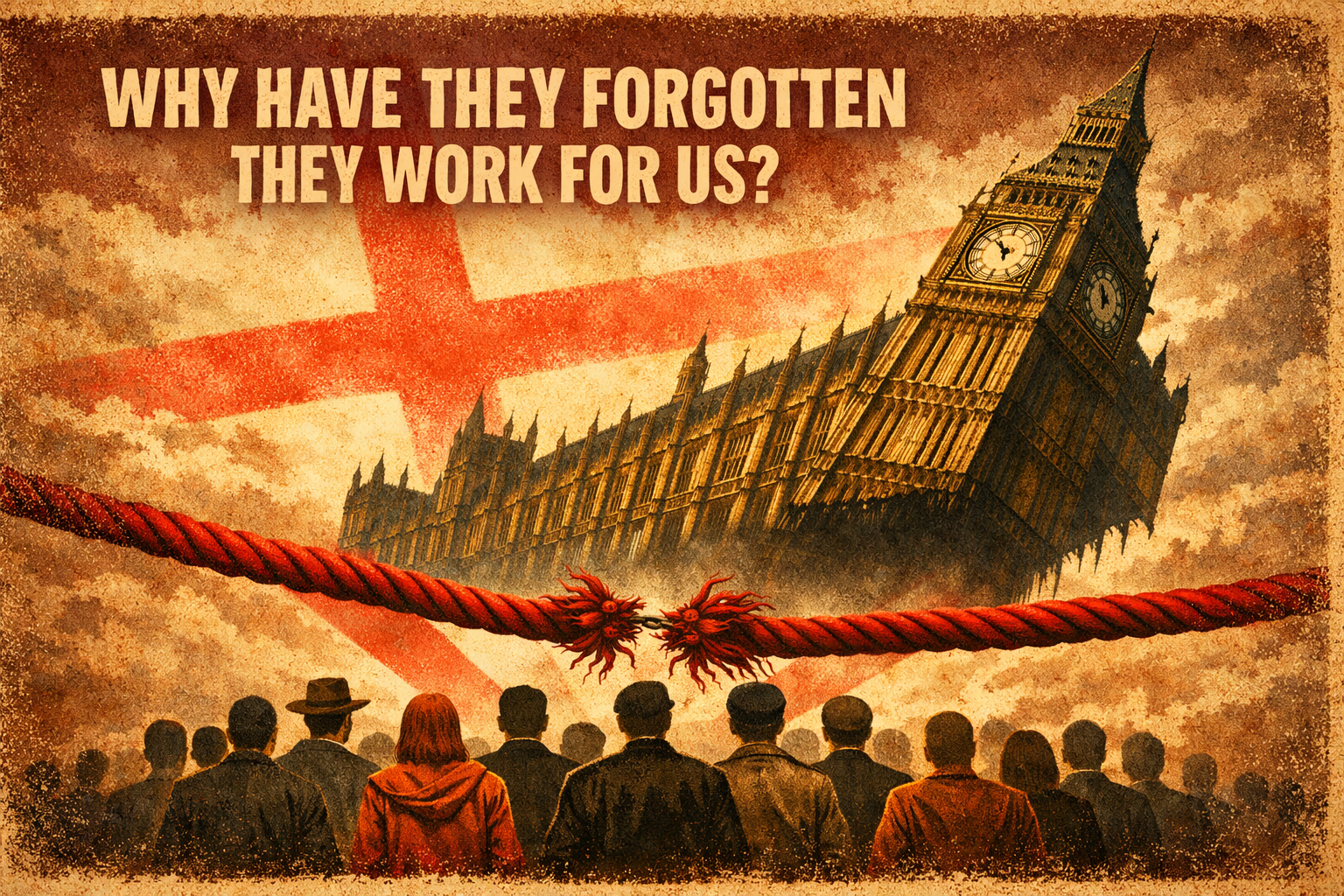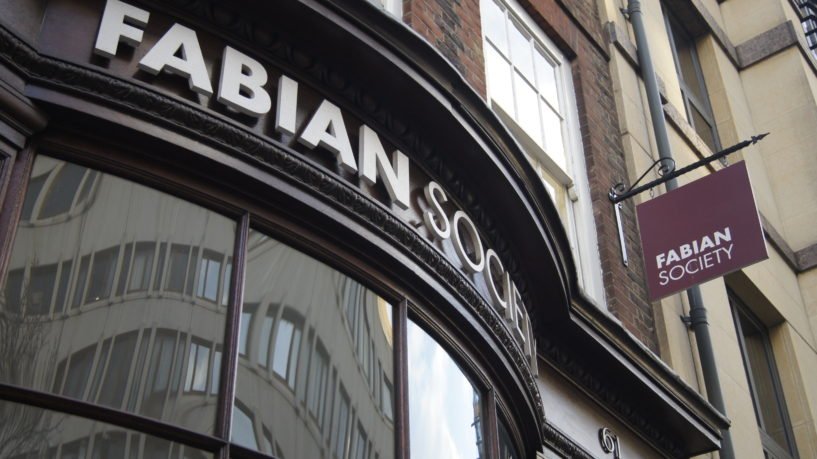
There’s a building in St James’s Square in central London that most people have never heard of. It has a blue flag, a grand entrance, and a number 10 on the door. It is not Downing Street. It is Chatham House — formally the Royal Institute of International Affairs — and it may quietly shape more of what happens to this country than the Parliament two miles away.
This is a piece about power. Not the theatrical kind — the speeches, the elections, the shouting on Question Time. The real kind. The kind that decides which ideas are “serious” and which are “dangerous”, which policies get written into strategy documents, and which concerns of ordinary people get dismissed as ignorance or bigotry.
It is also, at the end, a piece about litter.
The Think Tank at the Centre of Everything
Chatham House is funded by a remarkable combination of sources: governments, foundations, and corporations — including, according to research by the Campaign for Nuclear Disarmament, companies involved in arms manufacturing such as BAE Systems, Boeing, Airbus, Lockheed Martin, Leonardo and Rolls-Royce. Its governance draws on ex-ministers, ex-diplomats, ex‑intelligence and military figures. People who shaped the current system are overseeing independent analysis of that same system.
Its power is not formal. It cannot pass laws or order troops. What it can do is set the agenda — decide which topics ministers think about, provide the language in which they discuss them, and convene the private meetings where elite consensus forms. Their staff openly describe influencing UK foreign policy as core to their mission. When Chatham House says something, the Foreign Office listens. When they brief a parliamentary committee, their words end up in White Papers. When they host the Foreign Secretary, they frame the “serious” options.
It is soft power. But do not mistake soft for weak.
The critical question is not whether this influence exists — it clearly does. It is whether an institution funded partly by arms corporations and staffed by former architects of current policy can truly be independent. Critics, including CND researchers, argue it cannot — not because anyone writes a cheque marked “say this”, but because structural reliance on those funders makes certain conclusions simply unavailable. The range of “respectable” debate narrows, and narrows again, until the only serious options on the table are the ones that suit those who paid for the table.
What Happens When the Establishment Loses Power?
Which brings us to Rupert Lowe and Restore Britain.
In February 2026, just weeks after launching his new party, Lowe said he would abolish the British Nationality Act 1948/81. To most voters, this meant nothing. To the English constitutionalists who have been quietly building their movement for years, it meant everything.
The British Nationality Act 1981 — which replaced the 1948 Act — was the pivotal moment when “British” shifted from a territorial identity to a descent-based one. Before 1983, if you were born in the UK, you were British. After 1983, you were only British if at least one parent was already settled here. It ended birthright citizenship. It created the legal architecture that makes everything else Restore is proposing theoretically possible. And almost nobody in mainstream politics knows or mentions it.
That is not an accident. Reaching for that specific reference within weeks of launching a party is not the vocabulary of a former football chairman turned politician. It is the language of advisers who have been studying English constitutional law for decades, waiting for the right political vehicle.
The establishment’s response was immediate and predictable: the Guardian called Restore “far right.” Hope Not Hate published a case file within days. The label “Nazi” circulated on social media. What the establishment has discovered, too late, is that this playbook is exhausted. It has been deployed against UKIP, the Brexit Party, and Reform in sequence — and each time, the movements grew anyway. When every departure from the consensus gets called fascism, the word loses its power to alarm.
There is a real distinction worth making here. The people I have spoken to who support Restore — and the many more who are drawn to its ideas without yet committing — are not racists or fascists. They are people who love England and grieve what it has become. That grief is legitimate. The question is only whether Restore’s programme is the right response to it.
The Legal Myths They Want You to Believe
One reason the establishment labels movements like Restore as dangerous is that it avoids having to engage with their actual arguments. So let us engage honestly.
Can England remove illegal immigrants? Yes — the law already allows it. The Immigration Act 1971 gives the Home Secretary clear powers. The current Labour government removed 16,400 people in its first six months and called it a record. The constraint is not legal; it is logistical. There are an estimated 700,000 to 900,000 people living here illegally. The UK currently manages around 9,000 to 10,000 enforced returns per year. Scaling that up by a factor of 30 requires detention capacity, receiving country cooperation, and aircraft — none of which currently exist at that scale.
Pakistan removed 1.5 million Afghans in roughly a year. This is true and proves that mass removal is physically possible. But Pakistan did it by operating outside international law — using police harassment, arbitrary detention, and coercion. Pakistan has not ratified the Refugee Convention. It also shares a land border with Afghanistan, so people could simply walk back. Every UK deportation requires a flight, a travel document, and a government willing to take the person. These are not excuses; they are logistics.
What about the ECHR? Here the debate is genuinely contested. Withdrawing from the Convention is legally possible — Article 58 provides the exit clause, and Parliament can repeal the Human Rights Act. But doing so triggers the termination of key parts of the UK–EU Trade and Cooperation Agreement, potentially breaches the Good Friday Agreement (experts are split on this, but the risk is real), and expels Britain from the Council of Europe alongside Russia and Belarus. Parliamentary sovereignty is real and domestic law can be changed. What cannot be changed by Act of Parliament is how other sovereign states and institutions respond.
The most interesting scenario is one almost nobody is discussing: what happens to these legal constraints if Scotland and Wales vote for independence? Under international law, England would be the “continuing state” — keeping the UN Security Council seat, the nuclear deterrent, and existing treaty relationships by default. But as the continuing state, it could also choose to withdraw from specific treaties from a position of strength. The Good Friday Agreement constraint largely dissolves. The entire legal landscape resets. There are English constitutionalists — the same people in Lowe’s ear — who believe this is not a risk to be managed but an opportunity to be seized.
The Establishment’s Own Dirty Linen
It is worth pausing on Hope Not Hate, since they have appointed themselves guardians of what political movements are acceptable.
Matthew Collins, one of their most prominent figures, has admitted on Good Morning Britain that as a National Front organiser he took part in an attack at a south London library that hospitalised 17 people — “mainly women, mainly Asian women.” He attacked them with hammers and chairs. He has said on television, in his own words: “I stood there and thought, I’m absolute scum.”
Collins subsequently became an informant, helped dismantle far-right networks, and the establishment has redeemed and celebrated him. That redemption may be genuine. But an organisation whose founding figures include someone with that history, and whose researcher was caught on film under a Soviet flag calling followers “our Red Army,” is not a neutral arbiter of political acceptability. It is a politically motivated pressure group that uses the language of anti-hate to shut down conversations it finds inconvenient.
This is not a defence of actual extremism. It is a call for consistency.
What We Actually Lost — and Why
Here is the piece that rarely gets said plainly.
When I lived and worked in Oman, the streets were spotless. And because they were spotless, nobody dropped litter. That is not a trivial observation. It describes something profound about the relationship between a community and its environment, between how a place looks and how people behave in it.
In criminology it is called Broken Windows theory: a well-maintained environment signals that standards are enforced and people care; a neglected one signals that nobody is watching and anything goes. New York applied it in the 1990s and crime fell dramatically. But the deeper point is not about enforcement — it is about what social scientists call social capital. The invisible web of shared standards, mutual obligation, and trust that holds communities together.
England has been losing that web for forty years.
Deindustrialisation in the 1980s did not just destroy jobs. It destroyed the structures — the clubs, the pubs, the shared purpose — that organised working-class life. Mass immigration without integration created communities living alongside each other without shared identity. And perhaps most corrosively of all, political betrayal — the repeated experience of being told that your concerns are illegitimate, that noticing change makes you a racist, that no party actually speaks for you — has produced something that looks like hopelessness but is really suppressed fury.
People who feel they have a stake in something look after it. People who feel abandoned stop caring. The litter on England’s streets is not primarily a policing problem. It is a symptom.
The rape statistics are real — 777 reported rapes in London in January 2026 alone, 74,265 across England and Wales in 2025, a record high. Some of that rise reflects better reporting. Most reflects a genuine increase. All of it reflects a society in which women do not feel safe in ways they once did. The political class has failed to protect them — failed the grooming gang victims for decades through cowardice, and failed street-safety victims through an ideological framework that cannot discuss certain perpetrators without immediately short-circuiting into accusations of racism.
This is not a left‑wing problem or a right‑wing problem. It is a country that has lost confidence in itself and its institutions — and is now, tentatively, beginning to ask for them back.
An Honest Conclusion
I do not see myself as left or right. I take good ideas from wherever they come. I want to live in a safe country where women are safer. That is not a political position. It is a basic human aspiration.
What this conversation — from Chatham House to clean streets — has revealed is a system in which elite institutions shape the menu of options, arm companies fund the think tanks that advise ministers, ex‑spy chiefs lend their credibility to “independent” analysis, and anyone who asks awkward questions about any of it gets labelled and dismissed.
That system is now under pressure it has not faced before. Whether Restore Britain is the right vehicle, whether Rupert Lowe’s constitutional advisers have the right answers, whether the independence of Scotland and Wales opens the door to a rebuilt English settlement — these are genuinely open questions.
But the conversation is no longer avoidable. The people who built the current system, who funded the think tanks that rationalised it, who dismissed every challenge to it as dangerous — they no longer control what gets discussed.
That, at least, feels like progress.
If this piece made you think, share it. The conversation it’s trying to start is bigger than any one party or politician.