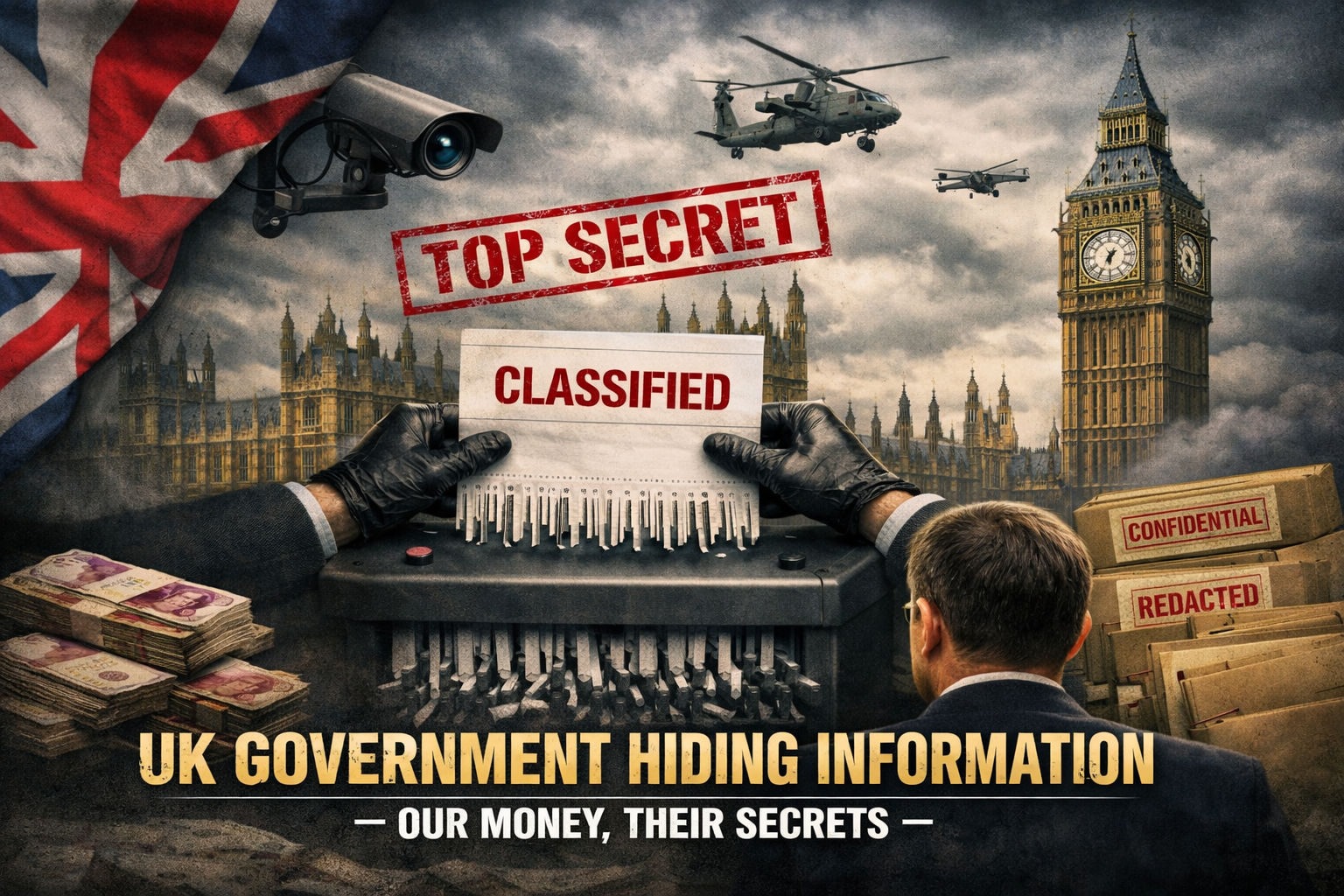
They work for us – so why are they hiding everything?
Here’s the thing that winds me up most.
We are constantly told “they work for us”. Parliament is “our” House. The civil service is “our” administration. The courts act “in our name”. That’s the script.
Yet when you look at how they actually behave, you see the UK government hiding information at every turn – and worse, spending our money to do it.
They don’t just keep us in the dark.
They send the bill.
They hire lawyers to block Freedom of Information requests. They use super‑injunctions to stop us even knowing a case exists. They drag their feet publishing contracts and reports. Then they lecture us about “trust” and “confidence”.
I’ve been watching Westminster closely for over 40 years. I’ve seen them lie, spin, and rewrite history more times than I can count. But there’s something particularly sick about this:
They work for us.
They use our taxes.
And they spend that money to stop us finding out what they’ve done.
How can that be right?
What’s actually happening: secrecy on our pound note
This isn’t paranoia. It’s on the record.
openDemocracy dug into legal spending and found the UK government has spent at least half a million pounds on legal fees in the last five years trying to prevent the release of information under Freedom of Information law. Half a million just to stop us reading things we’re supposed to be entitled to see.
Not half a million on hospitals.
Not half a million on police.
Half a million on lawyers whose job is to keep us in the dark.
On top of that, we had the Covid contracts mess. The Good Law Project and others had to go to court to force basic transparency, because the UK government failed to publish details on £4.4 billion worth of coronavirus contracts in line with its own rules. At the same time, it quietly admitted that the Department of Health had spent £17 billion on coronavirus‑related contracts to private companies.
If you’d done nothing wrong, why hide the details?
Then you’ve got secrecy orders and super‑injunctions. The Economist reported on a British court lifting a two‑year super‑injunction that had concealed a catastrophic data breach exposing thousands of Afghans – and the government’s costly mishandling of it. For two years, the public were kept in the dark about something done in their name, with their money, under their flag.
This is what “UK government hiding information” looks like in practice: court orders, legal bills, late disclosures, redacted documents, and a culture that treats the public as a nuisance to be managed, not a sovereign people to be informed.
And I’m supposed to trust these people?
Why it’s happening: control, embarrassment and power
Why do they do it?
It’s not complicated. The UK government is hiding information for three main reasons.
First, embarrassment. Freedom of Information is an inconvenience because it drags their cock‑ups into the light. That’s painful. It’s easier to throw up excuses – “too costly”, “vexatious”, “not in the public interest” – and hope the requester goes away.
Second, control. Knowledge is power, and they’ve no intention of sharing either. An administration that’s serious about being accountable makes it easy for you to see where the money goes and who signed what. Westminster makes you jump through hoops, then charges you for the privilege when they drag you through court.
Third, protection of their backers. When you’ve got “dark money” sloshing around politics, and companies donating and then winning contracts, the last thing you want is a public paper trail. Transparency is dangerous if your entire business model is based on mates rates and revolving doors.
And running through all of this is a mindset.
They do not see England – or the wider public – as the boss. They see us as a problem. A noisy stakeholder. Something to be managed, not served.
So when you ask: why, when they work for us, do they spend our money to keep us in the dark in our country?
Because they don’t really believe they work for us.
They believe we live in their country.
Who is to blame: not just “the system”
It’s easy to say “the system” and leave it at that. It also lets a lot of very specific people off the hook.
There are concrete actors here:
- Ministers who sign off on fighting FOI requests instead of releasing documents.
- Senior civil servants who treat FOI as an annoyance, not a duty.
- Government lawyers who make their living arguing against transparency.
- A Cabinet Office culture that sees itself as guardian of the state, not servant of the citizen.
Then there’s the media.
Too often, the same outlets that talk about “holding power to account” are perfectly happy to sit on super‑injunctions and secrecy orders until a court lifts them, then act shocked at what was revealed. The story becomes “look what we’ve uncovered” when, in truth, they were gagged and went along with it.
And where are Parliament and the opposition? A few Honourable Members will bang on about FOI and data rights, and good luck to them. But the bulk of the political class has got very comfortable with opacity. In government, they use it. Out of government, they fantasise about using it when they get back in.
You and I are the only ones who don’t get a choice. The UK government is hiding information from us using money we didn’t offer, for secrets we didn’t approve, under rules we didn’t write.
If you hired someone to do a job, and they immediately changed the locks, shredded the invoices and billed you for their solicitor, you’d sack them on the spot.
Why is politics any different?
What a serious country would do instead
If we were a serious country – and I mean England taking itself seriously as a nation – this would not be tolerated.
A serious country would:
- Treat Freedom of Information as a right, not a favour.
- Enforce strict deadlines for responses, with automatic penalties for departments that stall or obstruct.
- Ban the use of public money to fight against the release of information, except in narrowly defined national security cases. No more half a million in legal fees just to keep the public in the dark.
- Automatically publish contracts above a certain value within a fixed time frame, with clear names, amounts and terms, so nobody has to drag it out through FOI.
- Require public legal advice on major decisions to be released after a set period, so we can see what ministers were told, not just what they claim later.
A serious country would also put teeth in the rules.
If a minister signs off on unlawful secrecy, they lose their job. If a department repeatedly breaks FOI law, its budget for comms and PR gets cut. If an official lies to a court or tribunal about what exists, they face personal consequences, not just a stern memo.
And above all, a serious country would never accept this core outrage:
That the state can use the public’s money to prevent the public knowing what the state has done.
If England wants to be that serious country, this has to be a red line.
What ordinary people can actually do
The usual trick when people like me say all this is to shrug and say, “Alright, but what can we do?”
Plenty.
First, stop treating transparency as a niche concern for journalists. FOI is not just for hacks and campaigners. It’s for you. It covers councils, police, NHS trusts, quangos – not just Whitehall. You can ask:
- How much your council spends on consultants.
- What local MPs claimed in expenses.
- How police handled a particular incident.
- What legal advice was given on a major local decision.
Second, support the people doing the heavy lifting. Groups like openDemocracy and others are literally paying lawyers and filing cases to force disclosure. If you can’t file FOIs yourself, you can at least back those who are trying to prise the lid open.
Third, make transparency non‑negotiable when candidates come knocking. Don’t settle for “I believe in openness”. Ask specifics:
- Will you support banning public money being used to block FOI?
- Will you support automatic publication of contracts over a set threshold?
- Will you back an English duty of candour law for public bodies?
If they wriggle, you’ve got your answer.
Fourth, use local examples. I’ve seen FOI expose everything from dodgy consulting contracts to police misreporting crime figures. It’s not abstract. It changes how people see their local state. Once you’ve had one good FOI “win” in your area, it becomes much harder for officials to treat you like a nuisance.
The UK government hiding information is a national story. But it’s also a thousand local stories: the school budget, the council plan, the hospital contract. The more we chip away, the less room they have to hide.
Why this matters now: trust, democracy and English self‑respect
Trust in government is already on the floor. Surveys show only about a quarter to a third of people say they trust the national government, far below international averages. You don’t rebuild that by gagging the public and redacting everything.
You rebuild it by showing your working.
Instead, we’ve got a UK government hiding information and then feigning surprise when people don’t trust them. We’ve got ministers who think secrecy is strength, and a civil service that thinks the English public are children who can’t be trusted with the truth.
As an English nationalist, I care about this because it goes deeper than policy. It’s about self‑respect.
A people who accept being kept in the dark are a people who have accepted their own irrelevance. A nation that shrugs when its own employees spend its money to hide things from it has already conceded the argument about who is really in charge.
We saw it with Hillsborough: decades of families fighting to force out the truth. We saw it with Covid contracts and the VIP lanes: lawyers needed just to make the state obey its own rules. We see it now with FOI and super‑injunctions.
How many times do we have to watch the same film before we say: enough?
Conclusion: stop paying to be lied to
Here’s the blunt version.
The UK government is hiding information and sending us the invoice. They work for us in theory, but in practice they treat us as mushrooms – kept in the dark and fed rubbish – and expect us to be grateful.
We have a choice.
We can keep nodding along, paying our taxes, accepting that “grown‑ups” in Westminster know best and we’re not allowed to see the receipts. Or we can say, as England, that we’re done funding our own ignorance.
Stop voting for people who think secrecy is their birthright. Support those, however rare, who are prepared to write transparency into law with real consequences. Use FOI. Back those who use it. And every time you hear a minister say “we work for you”, remember the legal bills they’ve run up trying to stop you reading what they’ve done.
They only get away with this because we let them.
Stop letting them.
Want to join other people who are sick of going it alone and actually want to make a difference?
Go to our campaign site They Work For Us and get involved.
One angry person shouting on their own is easy to ignore.
Thousands of us, standing together, are not.
FAQs
Q1: What does it mean when people say the UK government is hiding information?
It means ministers and departments are using legal tricks, delays and secrecy orders to avoid releasing documents, contracts and data the public is legally entitled to see, often spending public money on lawyers to do it.
Q2: How much has the UK government spent blocking Freedom of Information requests?
Investigations have found that over five years, at least half a million pounds of public money has been spent on legal fees to prevent the release of information under Freedom of Information law.
Q3: Why is it wrong for government to use public money to fight FOI requests?
Because FOI exists so the public can scrutinise what is done in their name; using public funds to block that scrutiny flips the system on its head and means citizens are paying for their own exclusion.
Q4: What can ordinary people do about government secrecy?
People can file their own FOI requests, support organisations that challenge secrecy in court, and pressure MPs and candidates to back stronger transparency laws and bans on using public money to obstruct access.
Q5: Is this just a UK problem or does it affect England specifically?
While FOI is UK‑wide, many of these decisions hit services and spending in England directly; for English nationalists, it’s about whether the English public is treated as a sovereign nation or as a population to be managed and kept in the dark.

6 thoughts on “UK Government Hiding Information – Our Money, Their Secrets”