
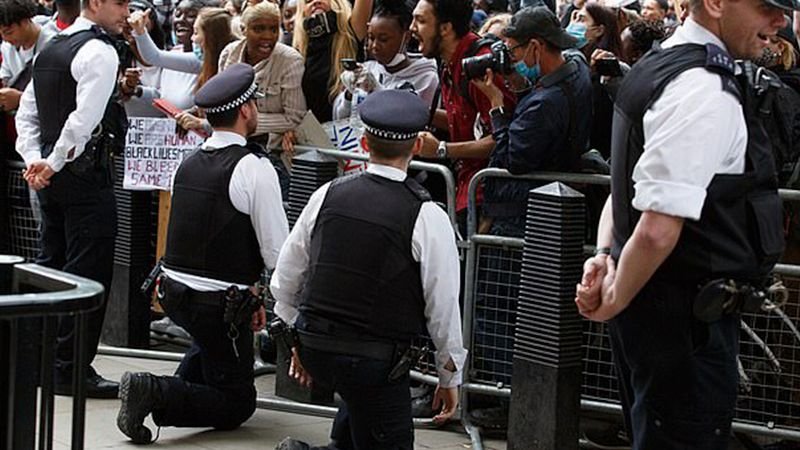
Two-tier policing is no longer just something people mutter about in pubs or on phone‑ins; it is there in black and white in policy documents, and we have now seen, in the most brutal way, what it looks like on the ground in the Henry Nowak case. In this article I want to talk plainly about two-tier policing / tiered policing, why so many of us are asking “are they even listening?”, how a young man could end up handcuffed while he was bleeding to death, and why – even after Henry – the people in charge are still pushing for more tiered policing in the name of “equity”.
Introduction: “Are they even listening?”
I have been watching British policing and criminal justice debates for close to four decades. I remember the fear around football hooliganism, the panic over knife crime, the era of “zero tolerance”, and the endless round of new “initiatives” rolled out with glossy brochures and solemn promises. You learn, after a while, to listen less to the speeches and more to what actually happens when an officer turns up in a street somewhere in England.
The phrase two-tier policing has taken off because people can see – and feel – that they are not all being policed in the same way. The Henry Nowak case has become a lightning rod for that feeling. An 18‑year‑old white student is stabbed, five times, in Southampton; when police arrive, they handcuff him and treat him as a suspect because his Sikh attacker alleges he used racist language. Henry later dies. The killer is rightly convicted and given a life sentence, but the question remains: why was a mortally wounded teenager treated as a problem to be “managed” rather than a life to be saved?
And here is the part that really grates for those of us who care about English ideas of equal justice: even after that, senior policing voices are not backing away from tiered guidance; they are defending it, arguing that the real danger is “rolling back” anti‑racist policies. So the purpose of this piece is simple. I want to pull apart what two-tier policing / tiered policing actually means, explain how we got here from Stephen Lawrence and Macpherson, and set out why the public’s growing anger – “are they even listening?” – is not some fringe obsession but a rational reaction to what we are all seeing.
What people mean by “two-tier policing”
Let’s start with basics. When most people talk about two-tier policing, they are not thinking about academic definitions. They are talking about the sense that if you swap the identities around in a story – change the race, the politics, the postcode – you will get a different response from the police.
In the current debate, there are two overlapping claims:
- First, that minority communities, especially black Britons, have historically been on the sharp end of police powers: more stop and search, more use of force, more suspicion, worse treatment in custody. And not without reason as the figures show they commit far more crime than the English. (Gov Crime Figures)
- Second, that in response to that history, and to inquiries like Macpherson, the system has now over‑corrected in other areas, so that when race is alleged, officers instinctively tilt in one direction – and that this can down‑grade white victims, especially if they are seen as “typical” or “privileged”.
The Police Race Action Plan (PRAP), issued by the National Police Chiefs’ Council (NPCC) and the College of Policing, puts this into formal language. It says that policing must “take account of the specific needs, circumstances and experiences” of individuals and communities, and it explicitly rejects “treating everyone the same” or being “colour blind”. In other words, tiered thinking is not a bug; it is a feature.
When people hear phrases like “race equity” and “specific needs” in a context where they already feel that basic services are failing, they put two and two together. That is why the phrase two-tier policing / tiered policing now dominates coverage of the Henry case and beyond: it captures the idea that there is no single, neutral rulebook anymore – there are tiers, and the tier you fall into shapes what happens next.
The Henry Nowak case: when tiers become fatal
Theories are one thing; what matters is what happens when a 999 call comes in. The Henry Nowak case shows us, in tragic detail, how tiered guidance can collide with real life.
The broad outline is now familiar. Henry, an 18‑year‑old student, was stabbed five times by a 23‑year‑old Sikh man in Southampton. The attacker alleged that Henry had used racist language towards him. When officers arrived, instead of focusing entirely on preserving Henry’s life, they restrained him, handcuffed him, and put him on his back while he complained he could not breathe. Video footage and eyewitness accounts have left little doubt that the basic duty of care – to treat the most seriously injured person as a victim first – was not the officers’ primary concern.
In the end, Henry died of his injuries. The attacker was convicted of murder and sentenced to life imprisonment with a minimum term of 21 years. But the court outcome does not erase what happened at the scene. It is there that the public saw two-tier policing / tiered policing in action: the allegation of racist language appears to have been given more immediate weight than the obvious fact that the person making no allegations at all – because he was fighting for breath – was the one who had just been stabbed.
Now, with nearly 39 years of watching this system under my belt, I can tell you this is not about one or two “bad apples”. This is exactly how people behave when they have been told, explicitly, in training and guidance, that being “colour blind” is wrong, that they must be acutely sensitive to allegations of racism, and that they will be judged not just on what they do but on how that behaviour is perceived through a race lens. You can almost hear the internal monologue: “We cannot be seen to dismiss this allegation; we must show we take it seriously.” And so a bleeding teenager becomes a suspect, because the tiers built into doctrine push officers in that direction.
“Even after Henry…” – the response that tells its own story
You might expect that a case like this would trigger a basic reset. A young man is dead; the footage horrifies the country; the concept of two-tier policing is on every front page. Surely, at this point, the people at the top would say: “We got this wrong. We put theory over basic duty. We are going back to one standard: preserve life first, deal with allegations afterwards.”
That is not what has happened. Instead, we have seen a pattern that will be very familiar to anyone who lived through the last few decades: review the wording, defend the doctrine.
The NPCC has said it will “review” the PRAP guidance, especially the sentence about not treating everyone the same or being colour blind. Ministers have complained that the wording is “unhelpful” or “poorly expressed”. But when you listen closely, they are very careful not to say that the underlying approach – building race‑based tiers into police thinking – is wrong.
Abimbola Johnson, who chairs the independent scrutiny board for the Police Race Action Plan, has been even more explicit. She argues that policing still contains “racism, discrimination and bias”, and that the real problem is that progress has not gone far enough, not that the plan itself is flawed. In other words, from her vantage point, the danger after Henry is that critics might use this tragedy to roll back “anti‑racist” efforts, not that tiered policing might itself be part of the problem.
For those of us looking at this from outside the institutional bubble, this is where the “are they even listening?” feeling becomes overpowering. A teenager dies, after being treated as a suspect while he bleeds out, in a context where race‑based guidance is openly in force. The reaction is not to question whether that guidance has gone too far, but to insist that it is vital and must be defended – with perhaps a tweak to the language to calm the public. If that is not two-tier thinking about whose concerns matter, I do not know what is.
From Macpherson to PRAP: how we built the tiers
To understand why this is happening, you have to go back to the 1990s and the murder of Stephen Lawrence. Stephen, an 18‑year‑old black teenager, was killed in an attack in Eltham in 1993. The initial Metropolitan Police investigation was a disaster: suspects were not pursued aggressively, evidence was mishandled, and the family were treated with suspicion and disrespect. For years, the Met denied that racism had anything to do with it.
The Macpherson Inquiry, reporting in 1999, changed that. It concluded that the investigation had been “marred by a combination of professional incompetence, institutional racism and a failure of leadership”, and it defined “institutional racism” as the collective failure of an organisation to provide an appropriate and professional service because of colour, culture, or ethnic origin. Macpherson made 70 recommendations, from changes in the law and the recording of racist incidents, to reforms in recruitment, training, and accountability.
There is no doubt that Macpherson was a turning point. It was described as one of the most important moments in modern English criminal justice. Double jeopardy rules were eventually relaxed in serious cases; new oversight bodies and complaint mechanisms were introduced; forces were pushed to record racist incidents more consistently; and there was a long period where “institutional racism” was front and centre in official thinking.
The intention behind all this was understandable: to break the old pattern where racist murders could be mishandled with impunity and where black families were treated as a nuisance rather than citizens. But over time, the focus on race hardened into something else. Training courses and guidance documents did not just tell officers “do not be racist”; they told them that striving to treat everyone the same – the old “colour blind” ideal – was itself suspect. The Police Race Action Plan is the latest expression of that mindset.
Seventeen‑ or twenty‑year‑old constables sitting in those briefings pick up a very clear message: race is not just context; it is a decisive factor. When allegations of racism are made, you over‑correct if necessary; better to be seen to over‑react than to be accused of indifference. That is how you get to the point where the officer who worries most about being branded racist is more likely to handcuff a bleeding teenager than to look indifferent to an accusation.
Personal perspective: how the tiers feel on the ground
From where I stand, having watched this from the early 1980s through to today, the reality of two-tier policing / tiered policing is messy but undeniable. It is not a simple story of “police hate whites now” or “police always hate minorities”. The tiers cut across each other.
I have seen, again and again:
- Class tiers: middle‑class suburbs get more responsive, courteous policing; battered estates get slow responses and a revolving door of officers who barely know the area.
- Political tiers: protests with fashionable slogans are policed with kid gloves; gatherings seen as unfashionable or “right‑wing” get a sterner response.
- Identity tiers: minority communities often bear the brunt of stop and search and heavy‑handed tactics; majority communities can find their complaints deprioritised if they clash with an approved narrative.
The Henry case plugs straight into this pattern. A white teenager, a minority attacker, an allegation of racism: in a system where race is foregrounded as a decisive factor, you can see how officers slot people into roles before they have even properly assessed the scene. It is not malice so much as mental scripting: “If I get this wrong, I will be in trouble for not taking racism seriously.” And once the tiers are in your head, they are very hard to switch off.
The public can feel this, even if they cannot quote policy documents. People notice which protests are allowed to block which bridges; which crimes get national campaigns and which barely get a crime number; which words prompt instant arrests and which do not. Over time, they draw the obvious conclusion: there is more than one standard being applied.
Why “equity” language is making things worse
One of the most striking things about the current guidance is how openly it rejects equal treatment as a goal. The PRAP and associated documents talk about “equity”, not equality; about addressing “specific needs” and “lived experiences”; about moving beyond “colour blind” approaches that supposedly perpetuate injustice.
In some settings, that kind of language might be harmless waffle. In policing, it is dangerous. Here is why.
When you tell officers that treating people the same can be a problem, you invite them to treat people differently. When you tell them that race, or any other identity marker, must be factored into their decisions, you invite them to adjust their responses not just based on threat and risk, but based on who is standing in front of them. When you scold them for being “colour blind”, you create a constant background fear that if they do not emphasise race in their thinking, someone will accuse them of racism later.
None of this means you ignore real data on disproportionality. The evidence about racial disparities in stop and search (If correct and not because a certain kind are committing the crime in that area), and in some uses of force (as we have seen with the police battering protesters at the Henry Nowak protest), is serious and must be taken seriously. But there is a world of difference between, on the one hand, auditing outcomes, disciplining officers who abuse their powers, and improving training on de‑escalation, and, on the other, building a philosophy where race is a lever that changes how you treat people in the moment.
Once you go down that latter road, you are no longer trying to fix a single standard that sometimes fails. You are creating multiple standards. You are defining, in effect, a tiered policing system and then acting surprised when the public describe it that way.
“Chalk & cheese”: from Stephen Lawrence to Henry Nowak
By this point, if you are still reading, you probably feel the weight of Henry’s story and the wider sense that something is off. Before we finish, I want you to hold one more comparison in your mind, because it shows just how “chalk and cheese” the official posture is today compared with the 1990s.
In April 1993, Stephen Lawrence was murdered in an attack in south‑east London. The Metropolitan Police investigation was a disgrace: key suspects were not properly pursued, evidence was mishandled, and Stephen’s family were treated with a mixture of indifference and suspicion. For years, the Met leadership denied that racism had anything to do with it, blaming individual errors and “miscommunication” instead.
It took the Macpherson Inquiry, reporting in 1999, to force the issue. Macpherson concluded that the investigation had been “marred by a combination of professional incompetence, institutional racism and a failure of leadership”, and he made 70 recommendations that touched everything from law to training to oversight. The report was described as “ground‑breaking”, leading to major changes in how racist incidents were recorded, how double jeopardy operated in serious cases, and how police services across the UK thought about their own culture.
Now, the post‑Macpherson era was not perfect. Many of the promised reforms only half‑landed; racial disparities in policing have stubbornly persisted; and some officers treated the whole exercise as a box‑ticking exercise. But one thing stands out in hindsight: there was at least a willingness, however grudging, to admit that something systemic had gone wrong and that the basics had to be tightened.
Contrast that with Henry. An 18‑year‑old student, stabbed multiple times, plainly needing urgent medical care, yet treated as a suspect and restrained because his killer alleged he used racist language. There are protests, accusations of two-tier policing / tiered policing, and a furious public debate. But what does the institutional response look like?
Instead of the blunt honesty we eventually saw after Macpherson – “yes, we failed; yes, the organisation is at fault” – we get a defence of the very doctrines that helped create this mess. The NPCC promises to “review the wording” of the race guidance; ministers complain about “phrasing”; oversight figures insist that the real risk is to anti‑racist progress, not to ordinary citizens. Even after Henry, the core message is: the guidance is fine, the equity philosophy is sound, we just need to explain it better.
From where I sit, that is the chalk & cheese difference:
- After Stephen Lawrence, the system was eventually forced to accept that institutional racism and incompetence had to be tackled head‑on, and that the law and oversight mechanisms had to change.
- After Henry Nowak, the system seems more concerned with protecting its “equity” doctrine and tiered guidance than with admitting that those very tiers might have cost a young man his life.
The lesson we should have drawn from Macpherson is simple: you fix institutional failure by enforcing one clear standard of competence and fairness for everyone, and by removing people who cannot or will not meet it. Instead, over two decades, we have built an elaborate culture of different expectations for different groups, where some characteristics push cases up the priority ladder and others push them down. The old blind spots towards black families have not been fully cured; but we have managed to add a new blind spot – a deep reluctance to admit when “anti‑racist” policies have produced injustices of their own.
That is why, even after Henry, so many of us are asking: are they listening at all? If the state could be forced, after Stephen, to look itself in the mirror, why is it now so terrified of admitting that tiered policing has gone too far?
Conclusion: one standard of justice, or none
We are living through a moment that reveals a lot about the character of English policing. On one side, we have a clear, tragic example of what happens when race‑based tiers are allowed to override the most basic duty to preserve life. On the other, we have a set of institutions that seem more anxious about protecting their equity language than about restoring a single, comprehensible standard that any citizen – of any colour – can rely on.
Two-tier policing / tiered policing is not a conspiracy theory; it is what you get when you write, into policy, the idea that treating everyone the same is suspect. The alternative is not to go back to the bad old days of blind spots and denial. It is to insist that the law be no respecter of persons, that the national decision model be anchored in threat and risk rather than identity, and that every life – whether named Stephen, Henry, or anything else – be treated as equally worthy of urgent protection.
If you care about that, this is the time to act, not just to grumble. Write to your MP. Challenge your police and crime commissioner. Support organisations that push for equal treatment under the law. Ask, again and again, the most awkward question of all: why are you still defending tiered policing, even after Henry?
FAQs
1. What is meant by “two-tier policing”?
Two-tier policing refers to a situation where police respond differently to similar incidents based on who is involved – their race, class, politics, or other characteristics – rather than purely on the facts and threats in front of them. In the current UK debate, it describes the perception that identity factors, especially allegations of racism, can overshadow basic duties like preserving life and applying the same rulebook to everyone.
2. How does the Henry Nowak case relate to two-tier policing?
Henry Nowak’s death is seen by many as a tragic example of two-tier policing / tiered policing in practice. After he was stabbed five times, officers restrained and handcuffed him while he complained he could not breathe, apparently giving significant weight to his attacker’s allegation that Henry had used racist language. Critics argue this shows how race‑based guidance can distort on‑the‑spot decision‑making and lead to fatal errors.
3. What is the Police Race Action Plan?
The Police Race Action Plan (PRAP) is a document issued by the National Police Chiefs’ Council and the College of Policing, aimed at improving policing for black communities and addressing racial disparities in areas such as stop and search and use of force. It explicitly states that policing should “address the specific needs, circumstances and experiences” of individuals and communities, and that this does not mean treating everyone the same or being colour blind, which is at the heart of current concerns about tiered policing.
4. Did the Macpherson Report create two-tier policing?
The Macpherson Report, which followed the Stephen Lawrence case, did not call for two-tier policing; it focused on exposing institutional racism and professional incompetence in the Metropolitan Police and made 70 recommendations to improve fairness and accountability. However, over time, some of the cultural and policy responses – especially the move away from “colour blind” ideals towards “equity” language – have contributed to a mindset where identity is treated as a decisive factor in how officers respond, which can lead to tiered outcomes if not carefully controlled.
5. What can ordinary citizens do if they are concerned about two-tier policing?
Citizens who are worried about two-tier policing / tiered policing can take several practical steps. They can write to their MPs and police and crime commissioners, asking for clear commitments to equal treatment and for the removal of guidance that rejects treating everyone the same. They can support independent organisations that scrutinise policing, respond to public consultations on guidance and powers, and document cases where they believe double standards have been applied, helping to build pressure for a return to one standard of justice.
Complain about the police by clicking Here:
Write To Your MP by clicking Here:
[…] is what a completely equal police service looks like in practice: one set of rules applied to everyone. No special pleading, no categories […]