
I’ve Been Watching This For Over 40 Years And The Pattern Is Unmistakable
I have been following British politics and news for over 40 years. In that time I have watched governments come and go, seen policing styles change, and listened to more official reassurances than I can count. But one thing I have never seen is the British Establishment honestly confront an uncomfortable truth when they can redefine it instead.
That is exactly what is happening with 2 tier policing.
Every time the subject comes up, the response from politicians, senior officers, and the media is the same: “There is no two tier policing in the UK. We police without fear or favour.” Then they move on, as if saying it firmly enough makes it true.
But ordinary people keep asking the question. They see the videos. They read the reports. They watch two groups do similar things and get completely different responses from the same police force, under the same laws, in the same country. And they want someone to explain it honestly.
That is what this article is for. No spin, no political agenda, just a clear factual look at what 2 tier policing actually means, why the official definition is not the same as the real one, and why the pattern exists whether the Establishment admits it or not.
What Is 2 Tier Policing? Start With The Plain English Definition
Before anything else, let’s nail the definition, because this is where the argument starts.
“Two tier” is not a complicated phrase. In any context it means exactly the same thing: one way for one group, and a different way for another, inside the same system.
A two tier pay system means newer workers get paid less than older workers for the same job. A two tier justice system means some people get a faster, more favourable route through the courts than others. The law on paper might be identical for everyone. The experience of it is not.
So when you apply that logic to policing, the answer to “What is 2 tier policing?” is straightforward:
Under one legal system, the police consistently treat some people one way and other people a different way, even when what they have done is essentially the same.
The law is not different on paper. The enforcement is different in practice. And the difference tracks who people are, their race, their religion, their politics, their social status, rather than what they actually did.
Here is the test I would ask anyone to apply:
- Person A commits an offence and is arrested, charged, and publicly condemned.
- Person B commits a comparable offence and is barely challenged.
- The only meaningful difference between A and B is the group they belong to.
If that happens once, it might be an error. If it happens repeatedly, in the same direction, that is 2 tier policing. And no amount of official denial changes what you can see with your own eyes.
How The British Establishment Redefines The Term To Avoid The Question
Here is where it gets interesting, and where I think the public is being deliberately misled.
When politicians and senior officers push back on 2 tier policing, they almost always use a much narrower version of the phrase than the one above. They treat it as if it only means one very specific accusation: that police are softer on left-wing or minority protests and tougher on right-wing or nationalist ones.
They then answer that narrow version with their standard lines:
- “We police without fear or favour.”
- “The same laws apply to everyone.”
- “There is no such thing as two tier policing.”
And then they sit back as if the matter is settled.
But notice what just happened. They chose the narrowest, most politically loaded version of the phrase. They answered that version. And they left the broader question, about whether different groups routinely get different levels of enforcement, completely untouched.
That is not a rebuttal. That is a change of subject dressed up as a rebuttal.
It is also a classic framing tactic. By linking “2 tier policing” exclusively to certain political figures or movements, the phrase itself gets tainted. Now if you use it, you risk being dismissed as a troublemaker or associated with people the mainstream media has decided are beyond the pale. The uncomfortable factual question gets buried under a debate about who is allowed to ask it.
That is not honest public debate. That is reputation management for an institution that does not want to answer for its record.
What The Evidence Actually Shows
Let’s put the slogans aside and look at what the data tells us, because this is where the official position becomes very hard to defend.
Stop and search
Official government figures, year after year, show that Black people in England and Wales are stopped and searched at a significantly higher rate than white people, even after accounting for where people live and what the local crime picture looks like. This is not a fringe claim. It is in the Home Office’s own published statistics.
Use of force
Monitoring reports and independent reviews have consistently found that Black people are disproportionately likely to be subjected to police use of force, including Taser deployment. Again, this is not speculation. It is in the published data.
Charging and prosecution outcomes
Legal charities, barristers, and practitioners who work inside the system regularly report that people from certain backgrounds face different likelihoods of being charged or prosecuted for comparable offences. The pattern is widely acknowledged within the legal profession even when it rarely makes the front pages.
Public perception
Surveys consistently show that a large proportion of the British public believes the police treat some groups more leniently than others. Interestingly, different parts of the public disagree about which groups are favoured. But the core perception of uneven enforcement cuts across the political spectrum.
I have been watching these figures come out year after year and nothing changes. That tells you everything.
Now here is the critical point. None of this requires you to believe that every officer is personally biased or acting with malicious intent. What it does show is that the pattern of enforcement is not uniform. And when one legal system consistently produces different enforcement outcomes for different categories of people, it fits the plain English definition of a two tier system.
Two Events. One Country. Two Completely Different Responses.
You can read statistics all day. Sometimes two real events, in the same country, under the same laws, tell you everything you need to know.
London, June 2020.
Thousands of people gathered in central London for Black Lives Matter protests triggered by the death of George Floyd, a 46-year-old American man who died during a police arrest in Minneapolis. These were not small, quiet gatherings. They broke COVID lockdown rules that were still legally in force at the time, rules that banned gatherings of more than six people.
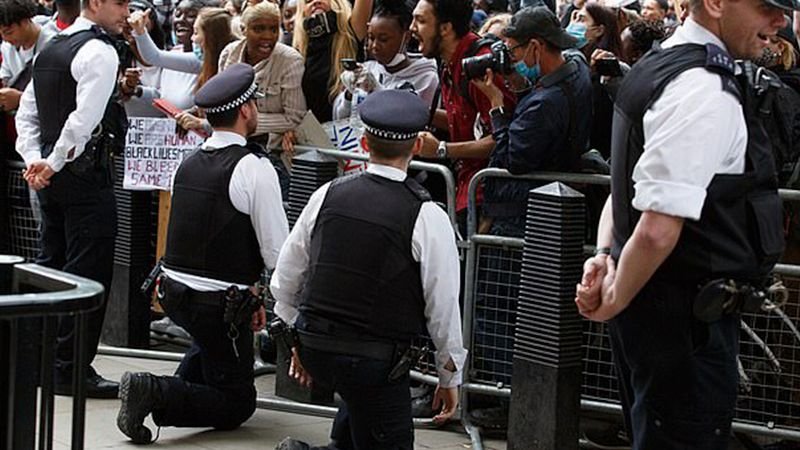
During those protests, Churchill’s statue in Parliament Square was graffitied with the words “was a racist.” Four uniformed officers stood nearby and watched it happen. At Downing Street, a Metropolitan Police officer was filmed getting down on one knee alongside protesters as the crowd cheered around him.
No riot shields. No police helicopter. No baton charges. Officers took the knee in the street.
Southampton, June 2026.
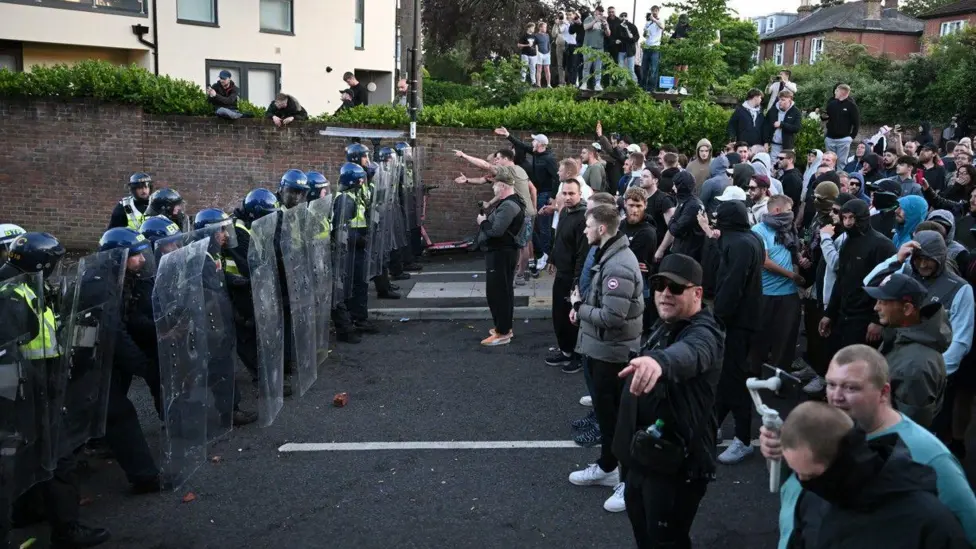
Henry Nowak was an 18-year-old university student stabbed to death on a night out in Southampton in December 2025. His killer, Vickrum Digwa, used an eight-inch ceremonial dagger. As Henry lay dying, Digwa falsely told police that Nowak had racially abused him. Bodycam footage later released showed Henry telling officers “I can’t breathe” at least seven times while handcuffed.
When people gathered in Southampton to protest about his death, the response was completely different.
Riot police. Shields. Pepper spray. A helicopter overhead. Officers charging into the crowd. Eleven officers were reported injured. Two arrests were made.
Now ask yourself the simple test from earlier.
Two sets of people. Both protesting. Both, at some point, involving disorder. Both under the same laws and the same policing principles. One group had officers kneeling with them as a war memorial was vandalised. The other had riot gear, shields, and a helicopter deployed.
What was the meaningful difference between them?
That is not a political question. That is a factual observation. And it is exactly what “What is 2 tier policing?” looks like when you stop reading the press releases and start comparing actual events.
Discretion Is Where 2 Tier Policing Actually Lives
This is the part that rarely gets explained clearly enough, so I want to spend some time on it.
The UK has one set of laws. That is true. But policing is not a mechanical process where the law automatically applies itself. At every single stage, human judgment and discretion are involved:
- Which areas and events to monitor
- Which protests to facilitate and which to restrict
- When to step in and when to stand back
- Who to stop and on what grounds
- Whether to arrest, warn, or walk away
- Which complaints to prioritise and which to treat as low-level
Two people can break the same law, in the same week, and get two completely different responses depending entirely on how that discretion is exercised.
On a case by case basis, that is understandable. No two situations are identical. Officers need judgment.
The problem is when the use of discretion follows a consistent pattern. When the same types of groups are repeatedly given the benefit of the doubt, and the same other types of groups are repeatedly hit with the full weight of enforcement, you no longer have individual judgment calls. You have a system operating differently for different people.
That is not about blaming individual officers. It is about recognising that 2 tier policing does not require a conspiracy or a memo from the top. It can emerge from accumulated decisions, institutional priorities, and operational culture that nobody at the top ever has to openly defend, because they can always point to the written law and say “same rules for everyone.”
The written law is not where the inequality lives. The discretion is.
Faith Groups, Community Engagement, And Informal Rule-Making
There is another dimension to this that does not get enough attention.
Police forces across England and Wales now invest significant effort in what they call “faith engagement” and “community relations.” There are toolkits, liaison officers, consultation frameworks, and ongoing relationships with religious and community leaders. On paper, this is about understanding the communities police serve and avoiding unnecessary offence or tension.
In practice, it creates a situation worth examining closely.
If certain religious or community groups have regular access to police decision-makers, and those groups can effectively signal which behaviours they consider acceptable or unacceptable, which forms of expression they want treated as hate and which they want protected, then the enforcement threshold is no longer set purely by law.
It is being shaped, at least partly, by which groups are organised, vocal, and have a seat at the table.
Ask yourself a simple question: if there is genuinely no 2 tier policing, why do police forces need bespoke faith toolkits and constant consultation with specific religious groups just to decide what they will and will not enforce?
The law already tells them what is legal and what is not. If they are applying it equally, the religion or community of the people involved should be irrelevant. The fact that it is clearly not irrelevant in the way operations are planned and resources are deployed tells you something important.
Equal treatment under the law should not require negotiation with community gatekeepers. The moment it does, you have moved away from “without fear or favour” and towards something else entirely.
Why Officials Can Deny It And Still Be Technically Correct
This section is important because it explains why the official position is not necessarily dishonest in a straightforward sense, it is just carefully constructed to avoid the real question.
When a politician or police chief says “there is no two tier policing,” they are usually speaking to a very specific, narrow definition. They mean: there is no written policy that says group A gets treated differently from group B. And on that narrow point, they are correct.
What they are not addressing is:
- Whether discretion is exercised differently across groups
- Whether operational priorities consistently disadvantage some communities
- Whether informal relationships with faith and community groups shape enforcement decisions
- Whether the outcomes of policing, by any measurable standard, are equal
By staying on the narrow ground of “the law is the same for everyone,” they can technically deny two tier policing while leaving every substantive concern about unequal treatment completely unaddressed.
There are a few other moves worth recognising:
The “historic” shift – Any inequalities that are too obvious to deny are labelled as historic or structural, something inherited, unfortunate, and nobody’s present fault. This moves responsibility safely into the past.
The “perception” defence – When pressed, the line becomes “we understand why people might perceive it that way” rather than engaging with whether the perception is accurate.
The credibility attack – Raise 2 tier policing and you may find yourself associated with people the media has decided are not credible. The phrase becomes radioactive enough that many people stop using it, which suits the Establishment just fine.
None of these moves answer the factual question. They are designed to end the conversation, not contribute to it.
How To Judge It For Yourself
Given how much noise surrounds this subject, here is a straightforward framework you can apply to any incident or pattern you see reported:
- What was the behaviour? Focus on the act itself: violence, threats, vandalism, hate speech, public order offences, peaceful protest. Be specific.
- Find a like-for-like comparison. Look for cases where the behaviour is comparable in seriousness, even if the groups involved are different.
- Compare the police response. Heavy presence and quick arrests, or hands-off facilitation? Charges brought, or a quiet walk away?
- Ask what changed between the two cases. If the behaviour is similar but the response is starkly different, what variable changed? Was it the group identity, the location, the media attention?
- Look for the pattern over time. One different outcome might be chance. The same difference, consistently, in the same direction, is a pattern.
This keeps the focus on testable observations rather than slogans. It does not require you to take any political side. It only requires you to look honestly at whether similar acts get similar treatment.
When they consistently do not, you are looking at 2 tier policing, regardless of what it is officially called.
Conclusion: The Standard Is Simple. Either Everyone Is Equal Before The Law Or They Are Not.
The principle of policing “without fear or favour” is not complicated. It means the same standard of enforcement applies to every person, every group, every community, regardless of race, religion, politics, or status.
That is not a right-wing idea or a left-wing idea. It is the foundational principle of equal treatment under the law. It is what the public has a right to expect and what every officer takes an oath to uphold.
When a police officer kneels in solidarity with one protest as a national war memorial is vandalised behind him, and riot shields and helicopters are deployed against another group mourning an 18-year-old student stabbed to death in the street, the “without fear or favour” standard is not being met.
You do not need a political allegiance to see that. You just need to be willing to look at both events honestly and ask the same question about both.
What was the meaningful difference?
2 tier policing exists. The question is not whether to acknowledge it. The question is whether anyone in a position of power has the honesty to stop defending it and start fixing it.
If this article gave you a clearer picture of what is actually going on, share it with someone who is still not sure what to think. The more people understand the real definition of 2 tier policing and see through the way the term is being managed and manipulated, the harder it becomes for the Establishment to keep changing the subject.
FAQs
1. What does 2 tier policing mean in simple terms?
2 tier policing means that under one legal system, the police consistently treat some groups differently from others, even when their behaviour is similar. It is about unequal enforcement in practice, not different laws on paper.
2. Does 2 tier policing require different laws for different groups?
No. In the UK the same written laws apply to everyone. 2 tier policing is about how those laws are enforced. If discretion is applied in ways that systematically favour some groups and disadvantage others, the outcome is still a two tier system regardless of what the legislation says.
3. Is 2 tier policing always a deliberate policy decision?
Not necessarily. It can emerge from institutional habits, operational priorities, and accumulated cultural norms rather than explicit instructions. But whether it is deliberate or not, the impact on the people experiencing it is the same.
4. How can I identify 2 tier policing when I see it?
Compare like for like. If two groups commit comparable offences but one consistently faces arrests and heavy enforcement while the other is largely left alone, and that pattern repeats over time, you are looking at 2 tier policing in practice.
5. Why do officials keep saying 2 tier policing does not exist?
Because they are answering a narrow version of the question. They focus on the fact that the same laws formally apply to everyone, which is technically true, while leaving broader questions about unequal enforcement, discretion, and outcomes completely unanswered.