When “Emergency Help” Became Everyday Life
If you’d told people in the 1990s that food banks would become part of everyday life in England, most would have laughed it off as unthinkable. Back then, the idea that families in one of the richest countries on earth would queue for basic food just to get through the week felt like something that happened “somewhere else.”
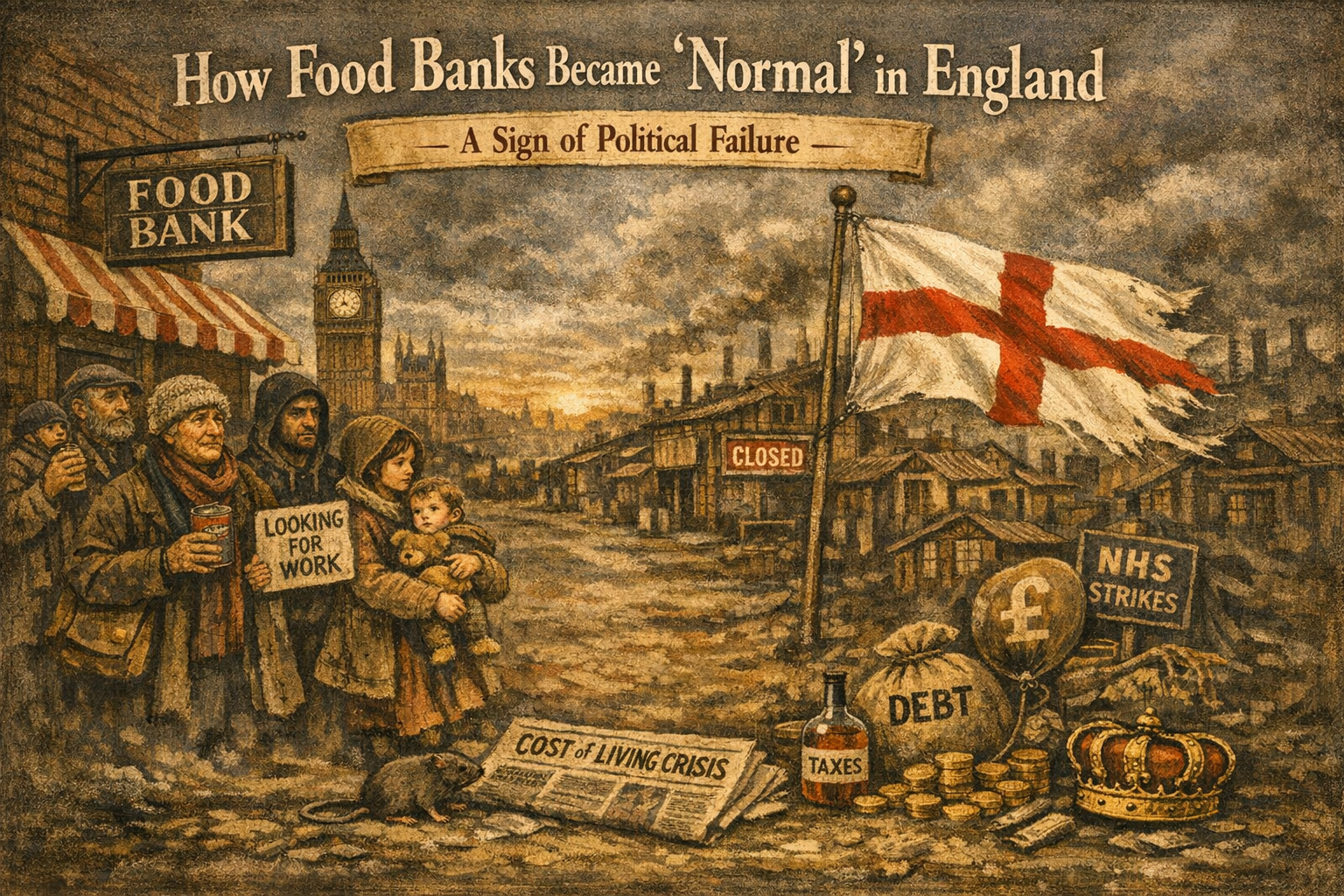
Yet around the year 2000, England’s first modern food bank opened its doors, and with it, a quiet but profound shift began. What started as an emergency measure for a few people in crisis has turned into a parallel system feeding hundreds of thousands. This wasn’t an accident. It was the moment our safety net started to tear — and successive governments decided to patch it, not with robust policy, but with charity.
In this article, I’ll walk you through how England’s first food bank came about, why its growth says so much about political mismanagement, and what that means for ordinary people today. I’ll share real-world examples, lessons I’ve seen play out over four decades of watching policy and poverty collide, and why the rise of food banks in England should worry all of us.
How England’s First Food Bank Started – And Why It Matters
The first modern food bank in England wasn’t built as a permanent institution. It was a response to immediate local need — a handful of people falling through the cracks, facing sudden crises like job loss, benefit delays, or illness. It was meant to be a stopgap, a bandage on a wound that policymakers would surely fix “soon.”
But here’s the crucial point: instead of asking, “Why are people so desperate that they need food parcels?” the political class largely celebrated food banks as a sign of “community spirit.” That sounds positive on the surface, but it conveniently distracts from the real issue — why the state’s basic duty to ensure people can eat was already failing.
From a political perspective, that first food bank in England became something more than a charity project. It was the canary in the coal mine. It warned us that the safety net — the system of wages, benefits, and services that’s supposed to stop people from freefalling into hunger — was no longer doing its job. Instead of being treated as a policy emergency, it was treated as a PR opportunity.
Food Banks in England: From Rare Exception to Normal Feature
Over the last 45 years, I’ve seen a pattern repeat itself:
- A new crisis hits (financial crash, austerity, COVID, cost-of-living spikes).
- More people can’t cover basics like food and heating.
- Instead of fixing the underlying causes, politicians shrug and point to “the wonderful work food banks are doing.”
That’s how food banks in England went from being rare to being normal. What used to be a last resort has quietly become a parallel welfare system. I’ve spoken to people who never imagined they’d cross the threshold of a food bank — people who work, people with qualifications, people raising kids solo, people caring for disabled relatives.
Personal example: I once heard from a working dad who said, “I have a job. I did everything you’re supposed to do. But when my hours were cut and our rent went up, it was either food or the gas bill.” He didn’t suddenly become irresponsible overnight. The problem wasn’t his character; it was the system around him.
The growth of food banks in England is not a story of increased “generosity.” It’s a story of policy choices:
- Freezing or cutting benefits while living costs rise.
- Allowing insecure, low-paid work to flourish.
- Designing complex systems that delay or deny people the support they’re entitled to.
- Mass Immigration of people with very low skills to appease big business.
When you look at it this way, each new food bank isn’t a success story. It’s a red flag.
Political Mismanagement: How Policies Pushed People to the Edge
You don’t get an explosion of food banks in England because millions of people suddenly forget how to budget. You get it when political mismanagement meets rising costs and stagnant incomes.
Let’s break down a few recurring themes I’ve watched over the years:
- Austerity and cuts to social security
When governments slash support in the name of “efficiency,” the impact isn’t abstract. It turns up in empty cupboards and skipped meals. People on the ground see it first: those managing food banks report spikes every time a new cut or rule change lands. - Benefit delays and sanctions
I’ve lost count of how many stories start with, “My payment was delayed,” or “I was sanctioned over a missed appointment.” If your income is already tight, a delay of a few weeks is catastrophic. Food banks become the emergency fallback for a bureaucracy that treats people as numbers, not humans. - Insecure work and low pay
The old assumption that “if you work hard, you’ll be fine” simply doesn’t hold for many people anymore. Zero-hours contracts, unpredictable shifts, and wages that don’t match local housing costs leave families permanently on the brink. You can’t budget your way out of structural low pay. - Housing pressures
When rents rise faster than incomes, something has to give, and it’s usually food. Nobody gets evicted for skipping a meal, but they can be evicted for missing rent. So food becomes the “flexible” line in the budget — and that’s when food banks step in.
All of this is avoidable. It’s the result of decisions: what gets funded, what gets cut, what’s prioritised, and who is considered expendable. When you zoom out, the rise of food banks in England is less about charity and more about a long trail of political decisions that shifted risk from the state to the individual.
The Human Cost Behind the Statistics
It’s easy to talk about food banks in abstract terms, but behind every parcel is a story — often a painful one. Over the years, I’ve come across a few patterns that come up again and again.
- Parents skipping meals so their kids can eat.
One mother told me she “wasn’t hungry anyway” — a line you hear often. In reality, she was rationing food so her children wouldn’t notice there wasn’t enough. - Older people choosing between heating and eating.
Some grew up in an England where social security meant you were looked after in old age. Now they queue quietly for tins and pasta, embarrassed to be there at all. - Workers who never imagined they’d need charity.
They often feel ashamed, as if they’ve personally failed. But when wages lag behind prices, and essential bills keep climbing, personal responsibility can only stretch so far.
What strikes me most is how people internalise this as a personal failure instead of a policy failure. They blame themselves, while politicians congratulate themselves on the “amazing community response” of food banks. That narrative is convenient for those in power, but it’s completely upside down.
How Food Banks Let Politicians Off the Hook
I want to be clear: the volunteers running food banks in England are doing compassionate, vital work. The criticism is not aimed at them. The problem is that their existence has been politically weaponised.
Here’s how it plays out:
- A government cuts support or allows costs to soar.
- People end up in crisis and turn to food banks.
- Instead of reviewing the policies that caused the crisis, politicians pose for photos at food banks, praising volunteers and “British generosity.”
It’s a neat trick. The focus shifts from “Why can’t people afford food?” to “Isn’t it wonderful that charities step in?” The responsibility is quietly moved away from the state, and the deeper structural issues get buried under feel-good stories.
Imagine a hospital where the roof is leaking and there aren’t enough staff. Instead of fixing the building or hiring more nurses, the minister praises the volunteers who bring their own buckets and mops. That’s essentially what’s happening with food banks in England: charity is being used to paper over cracks that should never have been allowed to form.
Why Normalising Food Banks Is Dangerous
One of the most worrying shifts over the last two decades is how food banks have moved from “shocking” to “normal.” Once something becomes normal, it stops feeling urgent.
People start saying things like:
- “Well, at least there are food banks.”
- “It’s good that communities pull together.”
Yes, community spirit matters. But it should complement a functioning safety net, not replace it. When the presence of a food bank is treated as a solution rather than a symptom, we’re in trouble.
Normalising food banks in England has three big consequences:
- Lower expectations of what government should do.
If we accept that food banks are just “part of the system,” we stop demanding that policymakers make sure people can afford food from their income and entitlements. - Stigma and silence.
People using food banks often feel ashamed, which keeps their experiences out of mainstream conversation. That suits those who don’t want this issue to become politically explosive. - Short-term fixes instead of long-term solutions.
When food parcels become the default response, there’s less pressure to address root causes: wages, housing, benefit design, and costs.
The first food bank in England should have triggered a national conversation about why it was needed. Instead, we got a slow drip of normalisation.
Where Do We Go from Here?
The story of food banks in England doesn’t have to end with permanent dependency and deepening inequality. But changing course means shifting from “sticking plaster charity” to serious political accountability.
That would look like:
- Designing benefits and support systems that are fast, fair, and sufficient to live on.
- Tackling insecure work and low pay instead of celebrating “flexibility” that only works for employers.
- Addressing housing costs so rent doesn’t swallow half or more of a household’s income.
- Treating food poverty as a policy failure, not a lifestyle problem.
- Remigrating millions of illegal immigrants, foreign criminals and people that can’t speak English.
None of this is radical. It’s the bare minimum you’d expect in a country that still likes to call itself advanced and fair. The first food bank in England was a warning. The question is whether we treat it that way — or just keep building more.
Conclusion: Don’t Accept Hunger as “Normal”
England’s first food bank was never meant to be the start of a new normal. It was a response to crisis, a signal that something had gone badly wrong in how this country supported its people. Yet instead of repairing the safety net, political mismanagement turned that one local solution into a nationwide crutch.
If there is one takeaway, let it be this: food banks in England are not a sign of success or compassion by those in power. They are proof that the basics — food, shelter, security — are no longer guaranteed, even for people who work, care, and contribute.
Your voice matters here. Talk about this openly. Challenge anyone who treats food banks as an acceptable long-term solution. Support charities if you can, but also support policies and candidates who are serious about making sure people can afford to live without relying on food parcels.
We should measure the health of a society not by how many food banks it has, but by how few it needs. Right now, we’re heading in the wrong direction — and it’s on all of us to say, clearly, that this isn’t good enough.
FAQs
1. When did food banks start appearing widely in England?
Food banks began to appear more visibly in England from the early 2000s onward, expanding rapidly as austerity, benefit changes, and economic shocks pushed more people into crisis.
2. Are food banks in England only used by unemployed people?
No. Many people who use food banks in England are in work but face low pay, unpredictable hours, high housing costs, or sudden financial shocks like illness or benefit delays.
3. Do food banks solve the problem of poverty?
Food banks provide short-term relief, but they do not address the root causes of poverty such as low wages, high living costs, and inadequate social security. They are a symptom, not a cure.
4. Why do politicians praise food banks if they show something is wrong?
Praising food banks allows politicians to highlight “community spirit” while sidestepping responsibility for policies that push people into hunger. It shifts attention from structural problems to charitable responses.
5. What can ordinary people do about the rise of food banks?
You can support local food banks while also pushing for deeper change: contact representatives, back policies that tackle low pay and high costs, share stories that challenge the idea that food banks are an acceptable long-term solution.