We can argue this without any tinfoil hat: for at least a decade, it has barely mattered who is PM – you get Davos and the World Economic Forum either way.
In this article I am going to show you, as plainly as I can, why an English Nationalist who actually cares about this country should stop pinning hopes on swapping leaders, and start talking seriously about sovereignty, the English constitution and draining the swamp that connects Westminster to Davos.
The Question Nobody in Westminster Wants Asked
I have been watching politics and policy for nearly 40 years.
In that time, prime ministers have come and gone – blue rosettes, red rosettes, a brief liberal flirtation, and the odd “change candidate” thrown in to keep us amused.
But one thing has stayed solid: every serious occupant of Downing Street ends up playing the same game with the same global club.
From David Cameron’s “Confident Future for Europe” speech at the World Economic Forum, to Rachel Reeves flying out to Davos in 2026 to tell billionaires that “Britain is the best place in the world to invest”, the pattern does not change.
So the honest English Nationalist question is this: if you always get Davos – whatever the ballot paper says – who is really running things?
What Davos Actually Is (And Why You Should Care)
Let’s strip away the marketing.
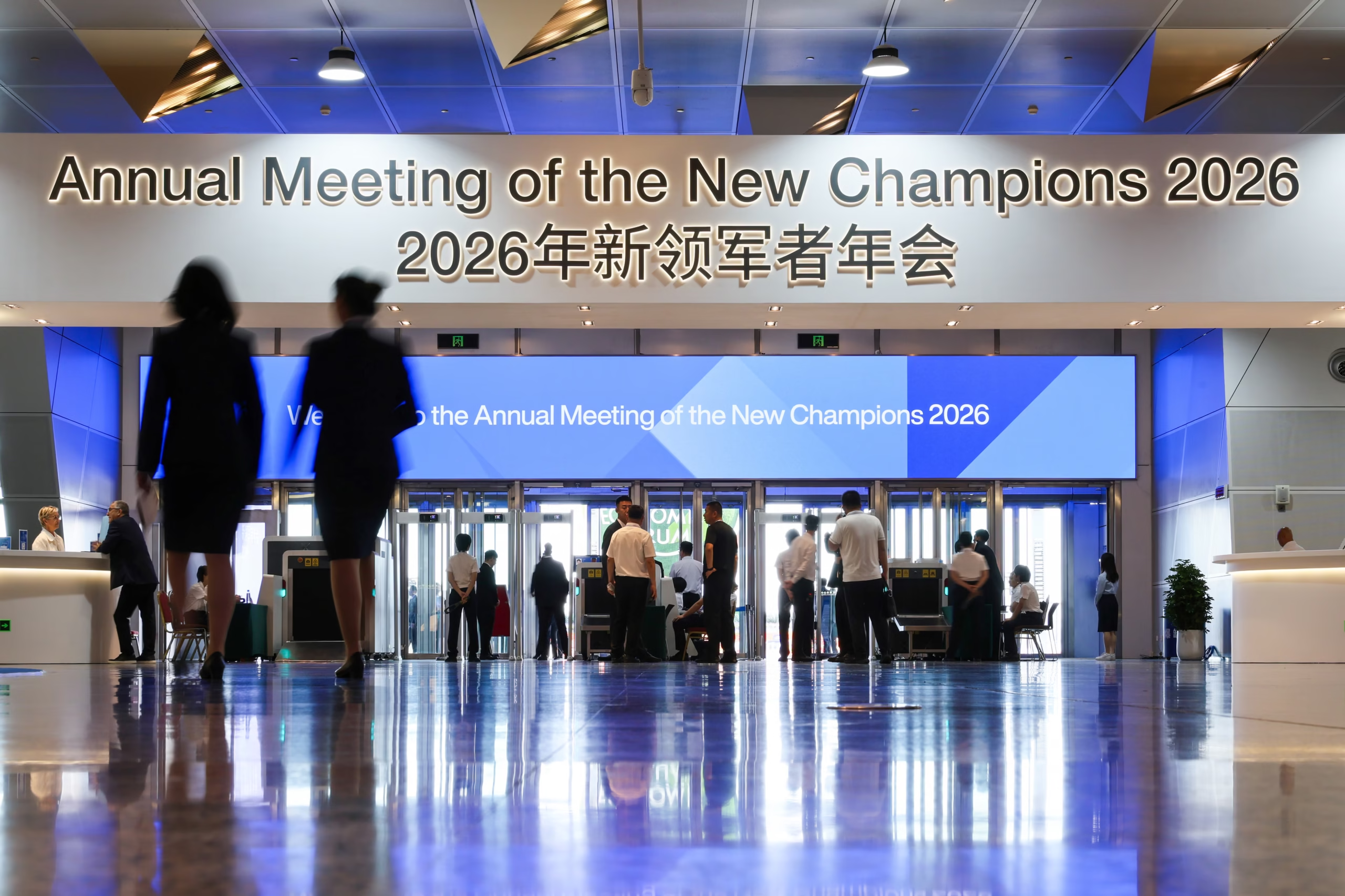
Each January, the World Economic Forum drags politicians, central bankers, corporate bosses and NGO heads up a Swiss mountain for its annual meeting.
The WEF describes itself as an independent international organisation that brings the public and private sectors together to “improve the state of the world”.
That sounds harmless enough, until you look at what actually happens:
- Deals, promises and “initiatives” announced on stage, then quietly baked into national policy later.
- Closed‑door sessions between ministers and multinationals, with no Hansard, no proper scrutiny, and certainly no English voter in the room.
- A constant drumbeat about “stability and certainty” for investors – language that quickly turns into pressure not to do anything too radical domestically.
Even Oxfam, hardly a nationalist outfit, now warns that Davos has become a symbol of “the rule of the rich”, with extreme wealth translating directly into political influence and the erosion of democratic control.
When the NGOs who share many of the WEF’s fashionable causes are openly saying this gathering is a threat to democracy, you don’t need to be far‑right or conspiratorial to smell a swamp.
A Quick Reminder: We Do Have an English Constitution
A big part of the problem is that we’ve been conditioned to think England has no real constitution, just a few conventions and some dusty parchments.
That narrative suits people who want power to drift away from the people without any awkward questions.
In reality, the English constitutional tradition is very clear on some basics:
- Parliamentary sovereignty means Parliament is the supreme legal authority in this country, able to make or unmake any law, and no other body has the legal right to override it.
- The Bill of Rights 1689 is still a living constitutional statute, limiting executive power, banning taxation without Parliament, and insisting that elections be free and Parliaments held frequently.
- The whole point of that settlement was to ensure we did not end up ruled by an unaccountable clique – whether that clique wore crowns, uniforms or expensive conference badges.
As one leading public law scholar puts it, parliamentary sovereignty means Parliament “has, under the English constitution, the right to make any law whatever” and no person or body is recognised as having the right to set its Acts aside.
That is a world away from the modern habit of treating Davos “frameworks”, global “principles” and private clubs as if they are somehow above what the English people vote for.
So if you are asking does it matter who is PM, you are really asking whether this constitutional principle still exists in practice – or whether WEF‑style governance has quietly replaced it.
The Davos Addiction: Same Script, Different Faces
Let’s pin down how deep the addiction runs.
David Cameron and Theresa May
Cameron took the classic route: special address at Davos in 2011, using the WEF stage to promote his vision for Europe and “unleashing” enterprise, with the UK government itself publishing the speech.
Theresa May followed in his footsteps, turning up in 2017 and 2018 to talk about “Global Britain”, free markets and making globalisation work for everyone, again in set‑piece addresses hosted by the WEF.
I remember watching those speeches live and thinking: you could wallpaper over the party logos and you wouldn’t know whether you were listening to a Conservative PM, a Labour one or a Brussels commissioner.
The phrases were interchangeable: stability, rules‑based order, investor certainty – all the buzzwords that play well in Davos.
Boris Johnson and Liz Truss
Johnson liked to mock Davos in public, calling it an “orgy of adulation”, but when it suited him he turned up anyway.
By 2023 he was on stage at the WEF‑week events urging allies to “double down” on Ukraine, using the forum to shape Western foreign policy.
Liz Truss is often held up online as the one PM who wasn’t “WEF approved”, yet the WEF has an official profile for her in its people directory from her time as Lord Chancellor and Justice Secretary.
Fact‑checks point out that she appeared on Davos panels as trade secretary and foreign secretary, just like the rest of the Cameron–May generation.
So much for the myth of the anti‑WEF rebel.
Rishi Sunak and Keir Starmer
As PM, Rishi Sunak did not always front the UK delegation in person, but his Treasury proudly talked about “the most visible UK Government presence in years” at Davos 2025, sending ministers to “bang the drum for Britain” in front of the WEF crowd.
By 2026, he was back in Davos as a former PM, talking about AI, regulation and geopolitics in interviews on the sidelines of the annual meeting.
Starmer and Reeves went even further.
The Financial Times recorded how, as opposition, they “talked up” Britain’s prospects ahead of high‑level Davos meetings, essentially using the WEF as a parallel campaign trail aimed at investors not voters.
By January 2026, Reeves was in Davos promising that Britain is “the best place in the world to invest” and pitching the UK as a “home of stability” to global business, with Treasury statements loud and proud about the government’s presence at the WEF.
When you step back and look at the last decade, one answer to “does it matter who is PM?” jumps off the page: not if your hope was that someone, anyone, would stop treating Davos as their private shareholders’ meeting.
English Nationalism: Not Little England, But Self‑Government
English nationalism gets written off as nostalgia or small‑mindedness.
In reality, the serious version of it is about adults wanting to run their own country again under their own rules.
From a constitutional point of view, an English nationalist position is almost boringly straightforward:
- The English people, through their Parliament, must remain the supreme source of law.
- International clubs – whether they are Brussels institutions, courts, or private outfits like the World Economic Forum – cannot sit above that sovereignty.
- Any government that behaves as if it is bound by Davos “consensus” rather than by the English constitution is acting beyond the authority it was given.
The Bill of Rights 1689 was designed to stop kings from suspending laws, levying taxes or keeping standing armies without Parliament’s consent.
Read that again, and then look at how casually modern ministers talk about “aligning with global standards” or “meeting international obligations” they picked up at WEF‑type meetings, often without serious debate at home.
An English Nationalist is not asking for royal absolutism in different clothes.
We are asking for the restoration of a very basic principle: no‑one has the right to override the will of the English people expressed through Parliament – not Brussels, not Davos, not some “multi‑stakeholder partnership” cooked up in a hotel bar.
Draining the Swamp: Practical, Not Fantasy
“Drain the swamp” gets dismissed as a slogan from another country.
But we have our own swamp, and it runs from Westminster to the conference rooms and side‑events around the World Economic Forum.
If we are serious about draining it, here are practical starting points:
- Full transparency on Davos involvement
Every minister’s Davos schedule, who they met, and what was discussed should be published, just like formal meetings with lobbyists in Whitehall. - No binding commitments outside Parliamentary scrutiny
Any “initiative” or “partnership” born at Davos that has domestic legal or financial implications should require explicit Parliamentary debate and approval. - Re‑affirm parliamentary sovereignty in statute
Parliament should restate in modern language that no international forum or “principle” has standing above Acts of Parliament, echoing the original logic of the 1689 Bill of Rights and later case law. - Stop bragging about being “most visible” at Davos
Government press offices should stop treating a bigger footprint at the WEF as a national success in itself. The real test should be whether policies benefit English communities, not whether they went down well in a Swiss ski resort.
None of this is extreme.
It is just applying our own constitutional principles consistently, instead of letting them be quietly eroded by the gravitational pull of an unelected global club.
So… Does It Matter Who Is PM?
Here is the uncomfortable answer from an English Nationalist who has been watching this circus for almost four decades.
Yes, it still matters who is PM on day‑to‑day issues – tax rates, local spending decisions, the way laws are drafted.
But if your question is “does it matter who is PM” in terms of our relationship with Davos and the wider World Economic Forum system, the evidence of the last 10–15 years suggests: not nearly as much as it should.
Unless and until we tackle the deeper issue – where sovereignty really lies, and whether the English constitution means anything in practice – changing the name on the door of No 10 is like changing the barman while the brewery stays the same.
If you want to “rule our country for our benefit again”, you cannot stop at party politics.
You have to think as an English constitutionalist: who authorised this drift towards governance by forum, and how do we pull power back to where it belongs?
That is the conversation our media avoids, our politicians dodge, and ordinary English voters now need to start having – loudly, repeatedly, and without apology.
Call to Action
If you have read this far, you are probably the sort of person who has already sensed that something doesn’t add up – that you keep changing governments and yet the direction stays the same.
Here is what I am asking you to do:
- Stop treating “does it matter who is PM?” as a throwaway line, and start using it as a serious question about sovereignty.
- Share this argument with people who still think Davos is just a harmless talking shop.
- Push your MP – whatever party they wear – to state clearly whether they think Parliament, or the World Economic Forum, is the ultimate reference point for UK policy.
If you want more no‑nonsense English Nationalist analysis like this, join my email list and share this article.
Because if we do not talk about who really governs this country, you can be sure Davos will keep answering that question for us.
FAQs
1. What is the World Economic Forum and why does it matter for the UK?
The World Economic Forum is a private organisation that hosts an annual meeting in Davos, bringing together political leaders, big business and NGOs to discuss global issues.
It matters because UK ministers and prime ministers use it as a platform to make promises to investors and “the international community”, often committing to directions of travel that voters have never explicitly endorsed.
2. Does the World Economic Forum make UK law?
No. The WEF cannot directly make UK law.
Under our constitutional principles, only Parliament can make or repeal laws, and courts still treat Acts of Parliament as the supreme source of legal authority.
The concern is not that Davos drafts legislation, but that it shapes the mindset and priorities of the governing class, which then writes laws to fit.
3. What does the English constitution actually say about sovereignty?
The English constitutional tradition, reflected in the Bill of Rights 1689 and later doctrine of parliamentary sovereignty, says Parliament is the supreme law‑making body and no other person or body is recognised as having the right to override its Acts.
That principle is still widely accepted in legal writing, even if political practice has drifted towards aligning with external forums and “commitments”.
4. Are all recent UK prime ministers linked to Davos?
Recent prime ministers of both parties have engaged with Davos in one way or another.
Cameron and May gave set‑piece WEF speeches as sitting PMs; Johnson and Sunak appeared at Davos‑week events after leaving office; Starmer and Reeves used Davos as a platform for their economic pitch.
Even Liz Truss, often portrayed as the “exception”, has an official WEF profile from her ministerial days.
5. What does an English Nationalist solution look like in practice?
In practical terms, an English Nationalist solution is about re‑asserting that Parliament, not Davos, is sovereign, and insisting on transparency and democratic control over any commitments ministers make in private.
That means forcing Davos‑linked deals through proper scrutiny, re‑stating our constitutional principles in modern statute, and refusing to treat alignment with WEF “consensus” as a policy goal in itself.