
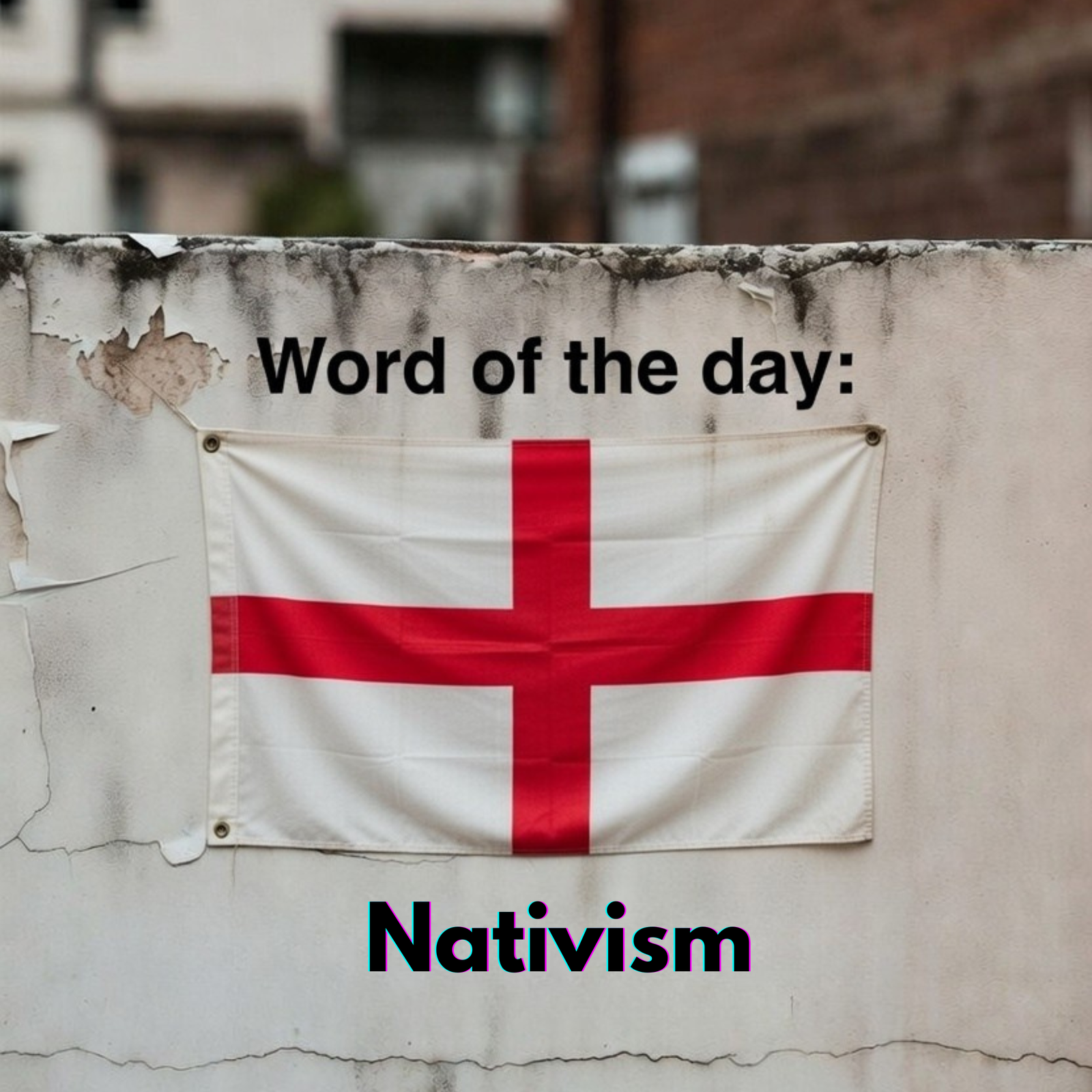
Nativism is suddenly the scary new word of the week. Say you think the state’s first duty is to its own people and you’re instantly labelled “far right” or worse. But step back for a moment and ask a basic question: if almost every country on earth quietly puts its natives first, why are the English told this is evil?
With England about to hit its 1,100th birthday as a united kingdom, it’s a good time to talk honestly about nativism – right or wrong? – and what it means for a people as old as ours.
What Nativism Actually Is (Not the Cartoon Version)
In politics, nativism simply means a belief that the interests of the native‑born or long‑settled population should come first when governments make decisions on immigration, borders and national life.
It normally includes things like:
- Preferring natives for jobs and welfare in times of pressure.
- Being cautious about large‑scale immigration that could disrupt wages or social cohesion.
- Wanting to protect the culture, identity and continuity of the historic people of a place.
Academics split hairs over “economic nativism”, “welfare nativism” and “cultural nativism”, but the instinct is the same: your own people first, others welcome but second.
You can agree or disagree with that instinct – but it’s not some alien fringe idea. It is how most of the world already thinks and governs.
England: A 1,100‑Year‑Old Nation
This isn’t happening in a vacuum. On 12 July 927, King Athelstan took York, forced the other kings to recognise him as “King of the English”, and effectively united England as one realm.
From that moment, you have:
- A named country: England.
- A recognised people: the English.
- A continuous political story that runs for over a thousand years, through invasions, dynasties, civil war and empire.
By July 2027, England will be about 1,100 years old as a united kingdom. That’s older than most modern states, older than the United Kingdom, older than every current political party and every international treaty we’re told we must obey.
So here’s the uncomfortable question: who gave any modern politician or court the moral authority to treat the English like a disposable variable – as if a people that old can be diluted, overridden or guilt‑tripped out of existence?
From that perspective, saying “the state should put the native English first” is not extremism. It’s basic respect for a thousand‑year‑old nation.
How the Rest of the World Does It
Look around and you quickly see that what we call “nativism” here is just normal statecraft elsewhere.
- Japan, South Korea, China – tightly controlled immigration, very hard to naturalise, clear expectation that the historic people remain dominant in their own homelands.
- Israel – openly defines itself as the nation‑state of the Jewish people, with a legal “right of return” that prioritises Jews worldwide.
- Gulf states – huge numbers of foreign workers, but strict rules on citizenship, property, and political rights to ensure locals remain firmly on top.
Even in classic “immigrant countries”:
- US, Canada, Australia run highly selective points‑based or skills‑based systems that ask whether migrants benefit the existing population – economic nativism in all but name.
International think‑tank pieces now talk about a “global nativist zeitgeist” because these ideas are moving the needle on policy, not lurking on the margins.
In other words: what gets shouted down as “nativism” in Britain is, almost everywhere else, just what governments quietly do for their own people.
Britain: Officially Anti‑Nativist, Practically a Mess
Britain is weird because the story our elites tell about this country does not match how most normal people think.
Since the late 1990s we’ve been sold a picture of the UK as:
- A “modern, open, global” country.
- Where “Britishness” is purely about values and paperwork, not about any historic people.
- And where worrying about the long‑term position of natives is automatically treated as morally suspect.
Meanwhile, a few awkward facts sit there in the data:
- Public opinion has consistently favoured lower immigration than we’ve actually had, especially among native‑born, non‑metropolitan and non‑graduate voters.
- Views on nation and identity are much more “grounded” than Westminster likes: plenty of people say ancestry, birth and long residence matter for being truly English or British.
Yet governments of all colours have presided over historically very high net migration, then padded it with slogans about “control” and “points‑based systems” while the numbers stayed up.
On paper they reject nativism. In practice they:
- Half‑copy globalist orthodoxy.
- Half‑react to public pressure with tough talk and small tweaks.
- And end up pleasing nobody: natives feel ignored, newcomers feel scapegoated, and the system is incoherent.
The Common‑Sense Core: Not Hatred, Just Boundaries
Underneath all the theory, the common‑sense position most people instinctively hold is roughly this:
Everybody should be equal before the law – that’s obvious. But when you move to another country, you’re choosing that country as it is. You’re accepting its language, customs and way of life. It’s normal to bring your own flavour, but it is not reasonable to demand that the native population rewrites their culture around you. At some point that stops being immigration and starts looking like a quiet form of colonisation – and most ordinary people, in almost every country on earth, instinctively know that’s wrong.
That’s not “hate”.
It does not say:
- Natives are superior humans.
- Outsiders should have no rights.
- Minorities can never belong.
It says:
- A historic people has a right to continuity.
- Newcomers should fit into a country, not attempt to refashion it around themselves.
- The state’s first duty is to the people who built and inherited the country – in England’s case, a nation 1,100 years old.
Common sense almost everywhere. Culture war in Britain.
Nativism: The Case Against (We Should Be Honest About It)
To be fair, there are real dangers here, and if you ignore them you hand your critics an easy win.
Critics argue that nativism:
- Can slip from “natives first” to scapegoating migrants for every problem – wages, housing, crime – even when the causes are mainly domestic policy failure.
- Can encourage zero‑sum thinking: any gain for newcomers is painted as a loss for natives, even where integration and contribution are real.
- Has a long history in some countries of overlapping with racism, eugenics and ugly conspiracy theories.
Those risks are real.
You can see them in US history (Chinese Exclusion, “Know‑Nothing” movements), in parts of Europe, and in how some politicians exploit anger rather than fix systems.
If nativism becomes nothing but:
- “Blame the foreigner”
- “Shut the borders, problem solved”
then it’s shallow and dangerous. It lets failed elites off the hook and turns neighbours into enemies.
Nativism: The Case For (Especially in a Country Like England)
But dismissing any concern for the native English as “racism” is just as crude.
One thousand one hundred years after Athelstan, it is not extreme for English people to say:
- We want to remain recognisably ourselves in our own land.
- We want immigration at a level we can absorb without losing our culture, cohesion and trust.
- We don’t want to become a minority in England without anyone ever asking us.
In fact, you can flip the usual moral framing on its head:
- Is it right to treat a thousand‑year‑old people as if they are temporary tenants in their own country?
- Is it right to brand any long‑term thinking about their future as hate, while other nations openly protect their own?
- Is it right to sign treaties, build systems and run policies that ignore clear public preferences and then shout “racist” when people notice?
When you phrase it that way, a moderate, rights‑respecting nativism looks less like extremism and more like basic self‑respect.
So… Nativism: Right or Wrong?
As with most serious questions, the honest answer is: it depends how it’s done.
- Nativism as a calm principle – “our first duty is to our own historic people; we welcome others who fit in and respect that” – is how most normal countries operate.
- Nativism as rage and scapegoating – “everything is the outsider’s fault, crush them” – is wrong and self‑destructive.
The problem in Britain is that our debate barely allows the first version without immediately accusing you of the second.
For England – a people with over a millennium of continuous history – that is absurd. No court, no party and no supranational body has the moral authority to tell the English they are not allowed to think about their own continuity, culture and place in their own homeland.
You don’t have to worship the word nativism. Use another label if you like. The core question is simple:
Does England, at 1,100 years old, have the same right as every other nation on earth to put its own people first in its own country – while still treating others decently?
If the answer is yes, then you already believe in a sane form of nativism, whether you use the word or not.
FAQ’s
FAQ 1: What does “nativism” actually mean?
Nativism is the view that a country’s government should put the interests of the native‑born or long‑settled population first, especially on immigration, borders and national life. It can cover jobs, welfare and culture – the idea that the historic people of a place have a special claim on it that must be protected.
FAQ 2: Is nativism just another word for racism?
No. Racism says some races are inferior; nativism says the state’s first duty is to its own people, whatever their race. The two can overlap in ugly ways, but many countries run interest‑based, nativist policies (on citizenship, land, migration) without preaching racial superiority.
FAQ 3: Do other countries really practise nativism?
Yes – often openly. States like Japan, Israel and the Gulf monarchies design migration and citizenship rules to preserve the position of their historic populations. Even the US, Canada and Australia use selective systems that ask if migrants benefit existing citizens, which is economic nativism in practice.
FAQ 4: How does England’s 1,100‑year history fit into this?
England was effectively united under Athelstan in 927, recognised as “King of the English”, giving you a continuous English kingdom and people for about 1,100 years. For a nation that old, saying “we want continuity for the English in England” is not extremism – it’s defending a long‑established people from being treated as disposable.
FAQ 5: Can you support nativism and still treat newcomers fairly?
Yes. A moderate nativism says: everyone here is equal before the law, but policy should not erode the culture, security and continuity of the native population. Newcomers are welcome on the understanding that they fit into the country they chose, rather than expecting a thousand‑year‑old nation to reinvent itself around them.