
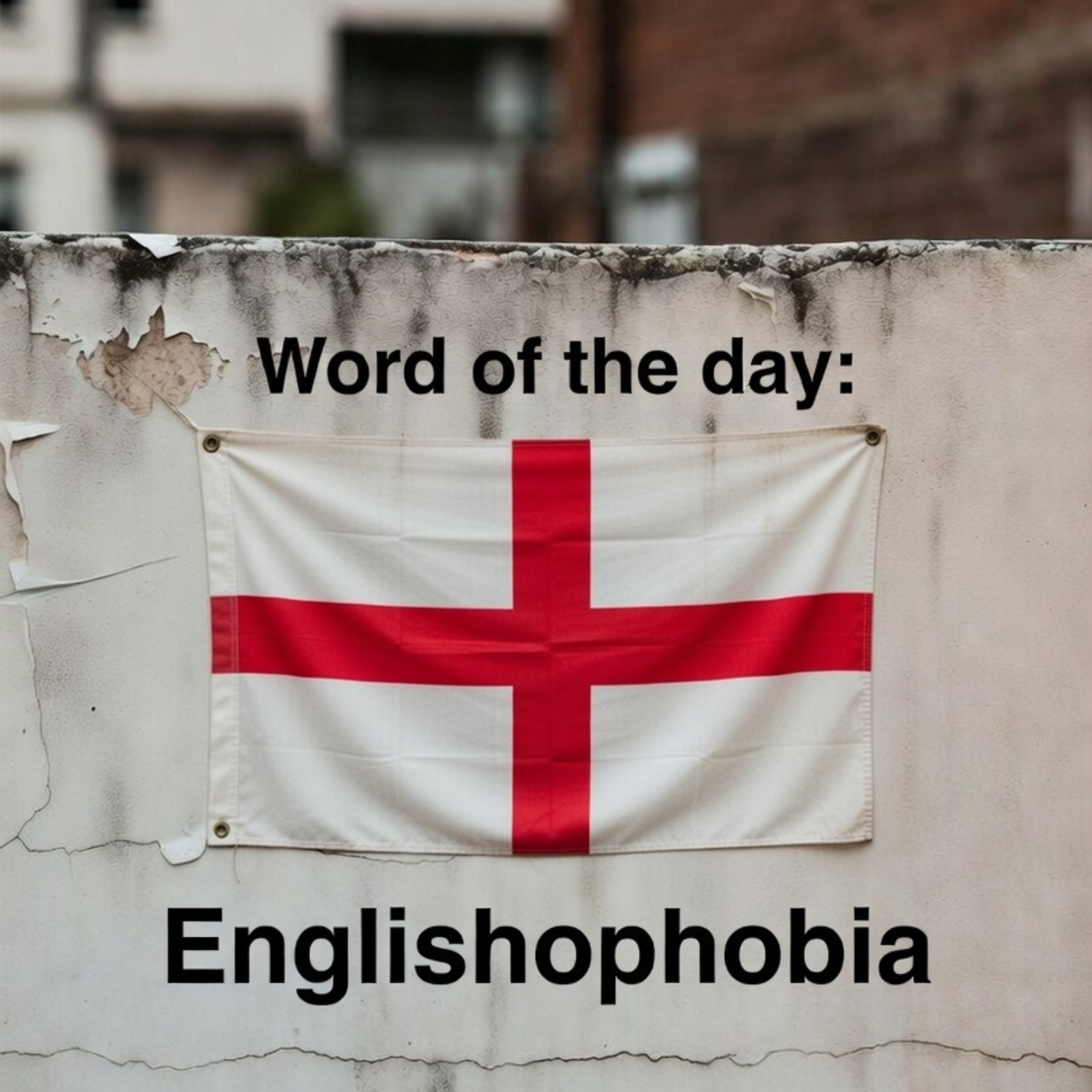
England today is drowning in talk of phobias – Islamophobia, homophobia, transphobia, xenophobia – you name it, it’s on a panel show tonight. But there’s one irrational aversion you will never hear named on the BBC or in Parliament: Englishophobia – the reflex hostility that erupts the moment anyone dares to speak about England as a nation and the English as a people.
This article asks a simple question: if every other group is allowed to name and challenge prejudice, why are the English the only ones told to shut up and be “British”?
What Is Englishophobia?
A phobia, in plain English, is an intense and often irrational fear or aversion. The term has expanded in everyday politics to mean hostility, contempt or prejudice directed at a particular group – Islamophobia, homophobia, transphobia and so on.
By that standard, Englishophobia is:
An abnormal, irrational hostility or aversion to England as a nation and the English as a people.
You see it every time:
- “British values” is fine – “English values” is suddenly “divisive” or “far right”.
- Scottish, Welsh and Irish nationalism are treated as normal expressions of democratic self‑determination.
- Say “England is a nation” and “the English have the same right to self‑government as anyone else” and the media sirens go off: racist, populist, extremist.
That is not calm disagreement. It’s a reflex. It’s Englishophobia.
A Country Obsessed With “Phobias” – But Not This One
Modern Britain has built a whole industry around hunting and naming phobias.
- Government‑backed work on Islamophobia, formal definitions, and ministerial groups to “tackle” it.
- Endless coverage of racism, homophobia and transphobia as the great moral questions of our age.
- Think tank reports, media monitoring projects and academic studies tracking “hate narratives” and “far‑right worldviews”.
Again, nobody serious disputes that anti‑Muslim hatred, racism or violent bigotry are wrong and dangerous. The point is this: hostility to English identity and English nationhood never makes that list.
You can cheer on every approved “phobia” awareness campaign and still pour open scorn on “Little Englanders”, “gammon” and “the thick English” – and no public body, broadcaster or regulator will ever call that a phobia.
If intense, irrational aversion to a group is a phobia, why doesn’t that rule apply to us?
How Englishophobia Shows Itself
Englishophobia isn’t usually a policy on paper. It’s a pattern of reactions. You see it in a few clear ways.
1. England May Not Be Named
- Newspapers and politicians talk about “Britain”, “the UK” or “these islands”, even when they’re describing something that only applies to England.
- Scotland, Wales and Northern Ireland are constantly named and recognised as nations with their own parliaments, parties and grievances.
- England – the country that pays most of the bills and holds the bulk of the population – is treated as an awkward word to be avoided.
This is not an accident. The post‑war settlement and the devolution fudge both rest on one quiet rule: England must never be allowed to stand up on its own two feet.
2. English Nationalism Is Pathologised
Ask why Scottish nationalism, Welsh nationalism, Irish nationalism – even Ukrainian and Palestinian nationalism – are routinely portrayed as understandable or even admirable, while English nationalism is smeared as inherently dangerous.
You don’t have to wave one flag or another to notice the double standard:
- Scottish nationalism = “a proud fight for self‑determination”.
- English nationalism = “proto‑fascism”, “xenophobic populism”, “dangerous nativism”.
The idea that only the English are not allowed to love their country without being psychoanalysed tells you everything about who is really considered legitimate in this Union.
3. Open Contempt Goes Unchallenged
Imagine a prime‑time guest casually sneering at “stupid Scots”, “thick Welsh”, or using a slur for any minority group. There would be outrage, complaints and likely a sacking.
Now watch how casually terms like:
- “Little Englander”
- “gammon”
- “backward English provincial”
are tossed around in supposedly respectable outlets and social media, with barely a raised eyebrow.
If constant, casual contempt for a group is a warning sign of bigotry when it’s aimed at anyone else, why does it get a free pass when it is aimed at the English?
Why The Establishment Needs Englishophobia
So why does the Establishment react so hysterically when England is mentioned?
1. England Blows Up the Devolution Fudge
Devolution created a lopsided setup:
- Scotland, Wales and Northern Ireland all gained national institutions and voices.
- England was chopped into “regions” on Whitehall spreadsheets and left voiceless as a distinct nation.
If England is allowed to exist politically, the questions write themselves:
- Why is there no English Parliament?
- Why do Scottish MPs still help decide purely English laws (the West Lothian question)?
- Why does the English taxpayer underwrite a Union that is allowed to despise them?
For a political class addicted to constitutional tinkering without real accountability, that is a nightmare. Much easier to declare English identity suspect and hope nobody asks.
2. The British Brand Depends on Diluting the English
After 1945 and especially after 1997, “Britishness” was turned into a kind of plastic, managerial identity:
- Anyone granted a passport is told they are equally “British”, regardless of history or roots.
- The language of citizenship and “values” replaces any talk of an actual historic people with continuity in a particular place.
If you admit there is a specific English people with a specific history, culture and claim on this land, that entire ideology is suddenly on shaky ground.
So the solution is simple: bury England inside “Britain”, and scream “racist” at anyone who tries to dig it out again.
3. English Identity Threatens the Narrative of “Far Right England”
A large chunk of modern commentary depends on the story that England is being dragged into a “far‑right” future. It’s a tidy narrative:
- English flags and St George’s Day are framed as suspect.
- Concerns about immigration, cultural change or national decline are bundled under “right‑wing extremism”.
- “The far right is remaking England” becomes a click‑friendly headline.
If the English start talking calmly and confidently about their identity, their history and their right to self‑government, that story falls apart. It turns out most people just want what every normal nation wants: a say over their own future in their own homeland.
For the media‑political class, that is terrifying – because it’s normal.
The Media’s Phobia Machine – And Its Blind Spot
Turn on almost any major outlet and you’ll find rolling treatment of:
- Islamophobia
- Anti‑Muslim bias in coverage and hate‑crime statistics
- Homophobia and transphobia as core tests of modern morality
These debates are backed by:
- Official definitions, like proposed Islamophobia wording to be adopted by public bodies.
- Government working groups and press releases on “tackling Islamophobia”.
- Media‑monitoring projects cataloguing negative coverage of Muslims and other minorities.
Yet there is no equivalent recognition that constant, casual dislike of the English – or open suspicion of English nationhood – might itself be a form of prejudice.
You will not see:
- An “Englishophobia monitoring centre”.
- A ministerial taskforce on “hostility to English identity”.
- Academic conferences on “pathologising English nationhood”.
Why? Because admitting Englishophobia exists would mean admitting the English exist – not just as barely‑tolerated passport holders, but as a historic nation entitled to a voice.
Is Englishophobia Real – Or Just A Clever Word?
Some will say Englishophobia is just a meme, a made‑up word to trigger liberals. But look at the criteria.
If a phobia is:
- An irrational or excessive aversion or hostility, often out of proportion to the actual object of fear,
- Directed at a group in ways that are normalised and unchallenged in mainstream spaces,
then ask yourself honestly:
- Is it rational that “English nationalism” is treated as uniquely toxic, when every other national movement is analysed with nuance?
- Is it rational that expressing affection for England and a desire for English self‑government gets you lumped in with violent extremists?
- Is it rational that open contempt for “the English” is a socially acceptable punchline on television?
If the answer is “no”, then Englishophobia is more than a clever term. It is a label for a real, deeply ingrained prejudice – and like all prejudices, naming it is the first step in dismantling it.
Why This Matters For England’s Future
Englishophobia is not just about hurt feelings. It has consequences.
- It silences legitimate English demands for fair representation and self‑government.
- It poisons debate by tarring normal patriotism as extremism.
- It weakens democracy by treating one historic nation within the UK as an embarrassment rather than a partner.
A Union built on the suppression of one partner’s identity is a Union built on sand. Scotland and Wales have learned to speak in their own names. Ireland always did. England is the last to find its voice – and that is exactly why it is attacked so hard.
Reclaiming English Identity – Without Apology
If you’re English, you are not required to apologise for existing. You are not required to hide behind “British” because it makes the right people feel safer on television.
You have the same rights as anyone else:
- The right to call your homeland by its name: England.
- The right to see yourself as part of a historic people: the English.
- The right to argue for political structures that reflect that reality – from an English Parliament to a rebalanced Union, or even independence.
None of that makes you “far right”. It makes you normal.
Englishophobia survives because it relies on silence and shame. Break the silence, and the shame starts to move where it belongs – away from ordinary English people, and onto those who have spent years telling us our very existence is a problem to be managed.
Final Thoughts – And A Challenge
If you believe all hatred and prejudice should be challenged, then you cannot in good faith carve out one exception for the English.
So here is the challenge to our politicians and commentators:
- If constant contempt and suspicion of a group is a phobia when it is aimed at Muslims, Jews, LGBT people or any minority, be honest and admit that the same logic applies when it is aimed at the English.
- If you really support equality, then stop treating English identity as something uniquely illegitimate, and start treating English people as what we are – a nation and ethnicity like any other, entitled to exist and to speak.
Until then, the word stands: Englishophobia – the Establishment’s last acceptable prejudice.
Use it today on your favourite social media lets see what responses we get and leave your comments below, It’s time we got everybody speaking English and Not British!
FAQ 1: What do you mean by “Englishophobia”?
Englishophobia is an irrational hostility or aversion to England as a nation and the English as a people, treating normal English identity and patriotism as suspect or dangerous. It shows up when expressions that are accepted for other nations – like wanting self‑government or celebrating national symbols – are smeared as “far right” only when the word “England” is involved.
FAQ 2: Isn’t “Englishophobia” just a made‑up internet word?
Most political “‑phobia” words began as non‑medical terms to describe intense dislike or prejudice, not clinical diagnoses. If we accept Islamophobia, homophobia and transphobia as labels for hostility to particular groups, there is no honest reason not to use Englishophobia to describe entrenched hostility to English identity.
FAQ 3: How is Englishophobia different from legitimate criticism of England?
Criticism is about specific policies, governments or historical events; Englishophobia targets the very idea of England and the English as inherently problematic. You can criticise any country without claiming the people themselves have no right to a distinct identity or normal national aspirations – with England, that basic line is crossed all the time.
FAQ 4: Does talking about English identity automatically make you “far right”?
No. English nationalism, in its core sense, simply asserts that the English are a nation and an ethnicity that have the same right to cultural continuity and self‑government as any other people. Serious surveys show most people in England feel both English and British, and want a democratic say over how their country is run – that is mainstream sentiment, not extremism.
FAQ 5: Can you be proudly English and still support other groups’ rights?
Yes – recognising English identity does not cancel anyone else’s rights; it puts the English on the same footing as Scots, Welsh, Irish and minority communities who are already encouraged to express their identities. In a genuinely equal society, English people should be able to say “I am English” and argue for England’s interests without being treated as a problem that needs managing.
[…] Englishophobia: Why English Identity Is Demonised […]
[…] Englishophobia: Why English Identity Is Demonised […]
[…] Englishophobia: Why English Identity Is Demonised […]