The early Black presence in England is too important to be left to people who treat history as a weapon instead of a record. This version of the article keeps that phrase as the core keyword, corrects the Windrush story, and ends with a clear statement of pride in a long English family line and in this country’s hard‑won achievements.
Introduction: Why the early Black presence in England matters
Every few months, another headline appears claiming that “Black Britons have been here from the beginning” or that “Britain was black for 7,000 years”, and the comments sections explode. For someone whose family’s roots in England stretch back more than four centuries, watching people twist this country’s story into slogans feels like a personal insult to the struggles and sacrifices that built the place we live in now.
This is not about denying anyone’s contribution or humanity; it is about protecting the integrity of English history from people who seem to either despise it or treat it as propaganda material. In this article, the early Black presence in England is taken seriously as a historical question, not a culture‑war toy, and the aim is to separate what the evidence really shows from the myths that rob all our ancestors—whatever their origin—of the respect they deserve.
England, not Britain: getting the labels right
Before even touching the early Black presence in England, the first job is to get the map straight. England is a historic kingdom; Britain is a geographical island; and the United Kingdom is a modern political state stitched together by acts of union, empire and war.
When TV clips or campaigning articles talk breezily about “Black Britons being here from the start”, they often slide between all three without noticing. One moment they are talking about a skeleton found in what is now Sussex or Somerset, the next they are implying something about the whole modern UK or even the empire—and that slippage makes honest discussion almost impossible.
From an English point of view, that matters. If an individual lived in Roman Londinium or Tudor Plymouth, they lived in a specific English place with its own parish records, laws and loyalties. Respecting those distinctions is part of respecting the people themselves, whether they were farm labourers in Devon, sailors from West Africa, or brickmakers on the Thames.
What the evidence shows: early Black presence in England
The phrase early Black presence in England can suggest two very different things. One is the serious historical question: were there Africans and other people of visible African descent living in England centuries ago, and in what numbers? The other is the political slogan: “England was black from the beginning,” which is not the same thing at all.
On the evidence side, historians and archivists have made real progress.
- Roman‑era records and skeletal remains from Britannia show that soldiers, traders and servants from North Africa and the eastern Mediterranean did pass through and sometimes settle in what is now England.
- Medieval and later documents reveal individuals of African origin in England, such as a Black labourer depicted in a thirteenth‑century Domesday manuscript and people with sub‑Saharan ancestry buried at places like Ipswich.
- Tudor and early Stuart parish records carry terms like “Blackamore”, “Moor” and “Negro”, marking baptisms, marriages and burials of Africans in English towns and villages.
These people were never a majority and often lived precarious lives, but they were there. As someone who has pored over English registers across four hundred years, there is a sense of kinship with anyone who appears in those fragile pages, whether they arrived from Cornwall or from the coast of Guinea.
What the evidence does not support is the lazy leap from “there were Africans here” to “England was black” as a sweeping, millennia‑long racial description. That leap does a disservice both to the tiny but significant early Black presence in England and to the overwhelmingly European, often desperately poor people who actually filled most of the parish rolls.
Case study one: Beachy Head Woman and the shifting story
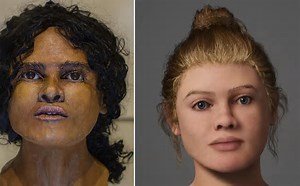
If there is a single example that captures how the early Black presence in England has been turned into a political football, it is Beachy Head Woman. Her skeleton, found in East Sussex and dated to the Roman period, became famous when an early analysis suggested she was of sub‑Saharan African origin, and museum displays celebrated her as one of the first Black “Britons”.
The story was compelling: a young woman with African ancestry living on the chalk cliffs of southern England; a neat answer to those who claimed Black people “only just arrived”. Exhibitions, plaques and TV segments followed, and she became an icon of the early Black presence in England—except that the science did not stand still.
Recent high‑quality DNA work by UCL and the Natural History Museum has overturned that earlier interpretation. The new analysis places her ancestry firmly in local Roman‑era southern England and suggests she had light skin, blue eyes and fair hair, rather than the picture that had been promoted.
For anyone who grew up visiting English museums with a stubborn pride—seeing one’s own country’s past laid out honestly in glass cases—discovering that an entire narrative had been built on such shaky ground sparks anger as much as disappointment. Not anger at the idea of diversity, but at the casual way in which people feel entitled to embroider England’s story for effect, as though the truth were not interesting enough.
Case study two: Cheddar Man and the temptation of headlines
Cheddar Man is another name that often appears in arguments about the early Black presence in England. When the Natural History Museum reconstructed his face from a Mesolithic skeleton discovered in Somerset, headlines shouted that “the first Britons were black” and social media turned him into a meme overnight.
The underlying work—using ancient DNA to estimate hair, eye and skin pigmentation—was academically serious but cautious. The public messaging, however, took that cautious science and turned it into a cudgel, with some commentators using Cheddar Man to declare that anyone proud of England’s history needed to “update” their identity overnight.
There is something almost obscene about watching people crow over a long‑dead hunter‑gatherer as a weapon in their domestic political argument. This man lived in a harsh environment, in a tiny band of people, thousands of years before England existed as a kingdom; yet suddenly he is pressed into service to mock people who feel attached to English continuity and the hard grind of their ancestors’ survival.
A more honest way to talk about Cheddar Man is to say:
- Early inhabitants of the land that would later become England probably looked different from later medieval English populations, and genetic models suggest some of them may have had darker skin.
- Over thousands of years, migrations from continental Europe reshaped the genetic makeup of the population, long before modern empire or recent migration.
That story is complicated, and it does not fit on a protest placard—but it respects both the science and the people whose bones are being handled.
Black Tudors and everyday life in English parishes
Where the early Black presence in England becomes most historically satisfying is not in the headline‑grabbing reconstructions but in the quiet grind of archival work. Researchers have combed through Tudor and Stuart parish registers, court records and household accounts to uncover Africans living in English communities between roughly 1500 and 1640.
These Black Tudors show up as musicians at court, servants in coastal towns, sailors in port communities, and, occasionally, free householders with some autonomy. Names like John Blanke, the Black trumpeter to Henry VIII, have become better known, but they sit alongside anonymous “blackamores” baptised, married or buried in parish churches from Plymouth to London.
For anyone who has spent long evenings tracing a family line through faded microfilm or online scans, there is something deeply moving about these entries. English history here feels like a shared ledger: one line might record a local ancestor, another a sailor from Spain, another an African servant, all subject to the same vicar’s hand, the same local weather, the same outbreaks of plague.
This is where pride in a long English lineage and respect for early Black presence in England can actually coexist rather than clash. Recognising that a few hundred Africans made lives in Tudor England does nothing to diminish the back‑breaking labour of farm workers in Norfolk or weavers in Lancashire; it simply acknowledges that England’s story has always had more threads than some people admitted.
From empire to Windrush: when numbers change
Where there genuinely is a large‑scale Black presence in England, it arrives much later. From the eighteenth century onwards, empire draws more people of African and Caribbean origin into English ports and cities, and by the mid‑twentieth century, the Windrush generation marks a clear turning point.
The famous arrival of the Empire Windrush at Tilbury in 1948 is often turned into a neat story: “they were invited to rebuild Britain”. In reality, the ship was a former troop carrier that stopped in Jamaica on a return voyage, with spare berths advertised in local papers; migrants—many of them ex‑servicemen—bought tickets with their own money and took a chance on England, rather than stepping off a specially chartered “invitation” ship. Britain did have labour shortages and a legal framework that allowed Commonwealth citizens to settle, but that is a very different thing from personally inviting those specific passengers.
Many of those who arrived faced rationing, racism and lousy housing, yet they worked, raised families and reshaped the cultural life of places the ancestors of long‑established English families had built up over centuries. Respecting the truth here means acknowledging both sides: that the Windrush pioneers were not chauffeured into a land begging them to come, and that once here, they grafted in the same unforgiving country that earlier generations of English workers had struggled to hold together.
To acknowledge this is not to sign up for slogans that erase the past. It is to say: England across time is big enough to contain both the long local roots of families who have been here for four hundred years and the more recent roots of families whose grandparents arrived from Jamaica, Nigeria or India.
What rankles is not the fact of that shared story, but the insistence from some quarters that the only way to acknowledge newer chapters is to trash or rewrite the older ones. Pride in one’s own English forebears—their hunger, their service, their small victories—should not have to be smuggled out of sight to make room for a fashionable version of the early Black presence in England that owes more to modern activism than to historical method.
How to read claims about “Black Britons from the beginning”
Given all this, it helps to have a simple checklist whenever someone insists that Black Britons—or, by implication, Black English people—have been here “from the beginning”.
- Which period of English history are they talking about?
Are they pointing to a single Roman‑era skeleton, a Mesolithic genetic model, a Tudor parish entry, or twentieth‑century migration? Each tells a different story and carries different weight. - Are they honest about scale?
One Beachy Head Woman, a few hundred Black Tudors, and the tens or hundreds of thousands who arrived after 1948 are not interchangeable numbers. Collapsing them into “we’ve always been here” may feel good, but it is not history. - How are “Black”, “English” and “British” being used?
A Roman‑era inhabitant of Sussex did not think of themselves as “Black British” in any modern sense. Modern racial categories, passports and political labels are being retrofitted onto people who would not recognise them. - What is the motive?
There are good‑faith efforts to restore omitted stories to English history, and there are people who simply want to score points against those they see as “too proud” of England. The tone usually tells you which is which.
From the perspective of a family that has weathered four hundred English winters, wars, recessions and political upheavals, it is hard not to feel disgust when that past is caricatured as a whitewashed cartoon that needs to be “fixed” by wishful thinking. The real early Black presence in England deserves better than to be used as a stick to beat the country with, just as the real struggles of long‑established English families deserve better than to be written off as the story of some imaginary “all‑white” island.
Conclusion: Pride in a hard‑won English story
The early Black presence in England is real, fascinating and worth teaching. It sits alongside, not on top of, the long story of English people whose roots run deep in the same parishes and counties, and both deserve honesty rather than weaponised myth.
For a family that can point to four hundred years of English ancestors—men and women who ploughed fields, worked pits, fought in wars, queued for rations and paid taxes—pride is not an optional extra; it is the only sane response. That pride does not require sneering at anyone newer to this country, but it absolutely does demand pushing back when commentators and campaigners try to rewrite England’s past to suit their politics.
This country is not perfect and never has been, but it is unique: a place shaped by countless small acts of duty, courage and persistence, from medieval serfs to modern migrants. If your own family’s story is part of that long chain, be unapologetic about your attachment to it—and when someone uses half‑baked slogans about the early Black presence in England to undermine that heritage, answer them with records, dates and evidence, not with silence.
If you found this useful, share it with others who care about England’s history and are tired of being shouted down; the more people who insist on evidence over propaganda, the harder it becomes for anyone—on any side—to drag this fantastic country’s past through the mud.
FAQs
1. Were there really Black people in Tudor England?
Yes. Parish registers, court records and household accounts show Africans living in Tudor and early Stuart England as servants, musicians, sailors and more, though in very small numbers overall.
2. Does the early Black presence in England mean England was once a “Black country”?
No. Evidence points to individuals and small groups of African descent rather than a majority Black population; modern slogans about England being “black for thousands of years” are not supported by the data.
3. Has the Beachy Head Woman story been corrected?
Recent ancient DNA analysis indicates that Beachy Head Woman most closely matches local Roman‑era populations in southern England, with no clear sign of recent sub‑Saharan ancestry and likely light skin, blue eyes and fair hair.
4. What does Cheddar Man actually tell us about early England?
Cheddar Man suggests that some early Mesolithic inhabitants of the region may have had darker skin and blue eyes, but he lived thousands of years before England existed as a kingdom and cannot be turned into a simple racial symbol.
5. Were the Empire Windrush passengers in 1948 “invited”?
No. Empire Windrush was a former troopship returning via Jamaica; spare berths were advertised and passengers bought tickets, although England’s labour shortages (Not helped by the £10 Pom Scheme) and lack of legal framework made their arrival possible and later generations have been described collectively as “invited” because various industries wanted “Cheaper Labour” to help rebuild (Not to be confused with today’s large corporations funding mass immigration so they have cheap labour).